
Think of the Salvation Army and you probably conjure up a uniformed brass band playing carols at Christmas, or bonneted lieutenants rattling collecting cans and selling “The War Cry”. The Army’s early days in Ripley were not quite so cosy, however.
The movement started by William and Catherine Booth in 1865 as the East London Christian Mission was renamed The Salvation Army in 1878. (Both William’s and Catherine’s families came from Derbyshire, by the way; his father was born in Belper and his mother in Somercotes so he knew the area well.) In 1880 there was the first recorded visit of the Army to Ripley when a group of “soldiers”, headed by “a female leader” held open-air services and meetings in the town. The Derbyshire Courier commented that it was “quite a novelty”.

They were not universally welcomed. The Derby Mercury called them “an alarming public nuisance” and reported that “scarcely a day passes but some member of the “Army” is charged before the magistrates with street obstruction or disorderly conduct.” There were frequent assaults on members of the Corps, whilst in Heanor, two young women, Captain Campbell and Lieutenant Frost, temporarily broke away from the movement over an argument as to how best to carry on their work in the town.
The Corps in Ripley seems to have been founded around October 1881. They officially opened on 29th December 1881, the first officer being a woman, Captain Griffiths. At this time the Derbyshire Times referred to them as “gangs of hymn-howling dervishes who parade our streets with deafening noises under the pretence that they are “Salvation” or “Gospel” armies.” A year later, the more conciliatory Courier reported on the Ripley Corps’ first anniversary, celebrated by a lavish tea (without alcohol, of course) and commented that “many drunkards have been made sober, and many miserable homes happy, by the advent of the Salvation Army into Ripley.”
Not everyone approved, though. In 1884, Dr Marshall Hooper, the chair of the Local Board, (and a Quaker) said that ”while believing in the freedom of religion, he had not at all admired the plan of the Salvation Army in going round the streets, especially at times when services were going on in the churches and chapels. They went about with their trumpets, triangles, drums and tambourines, and when he saw them going dancing and smiling and smirking along the road, he did not think that was any religion at all.” He later said that he thought the Board should have the power to compel the Army to “cease making such hideous noise during the time of public worship.”
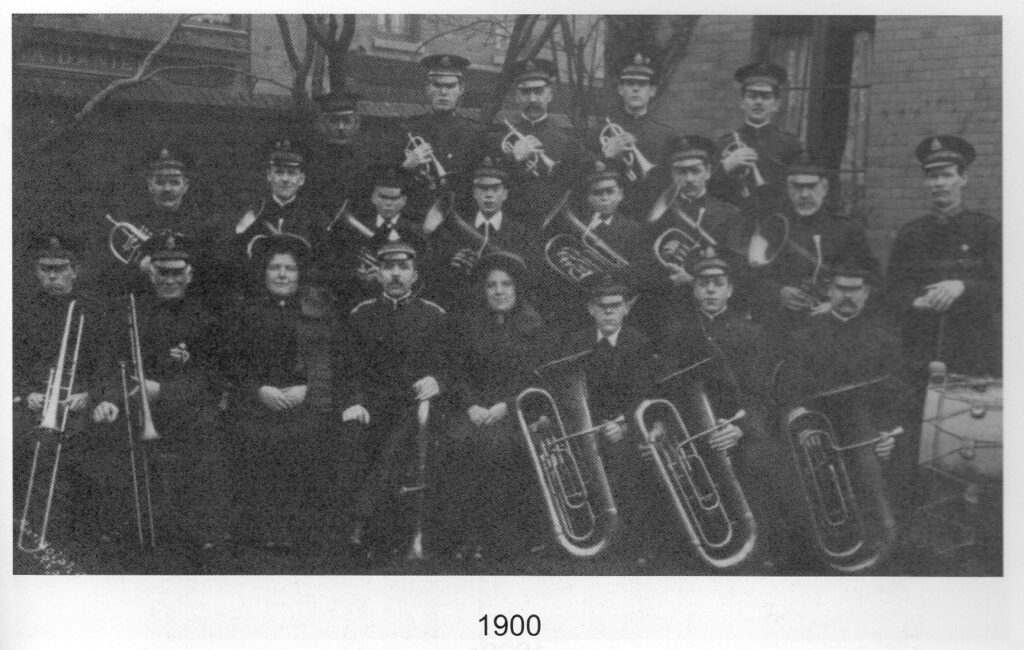
Meanwhile, the Army was increasing in strength. In 1886 it was reported that “a flying squadron, consisting of 19 females, arrived in a covered carriage at Ripley, from Belper.. and caused quite a commotion.” Assaults on salvationists continued, but the Army was gradually becoming more respectable.
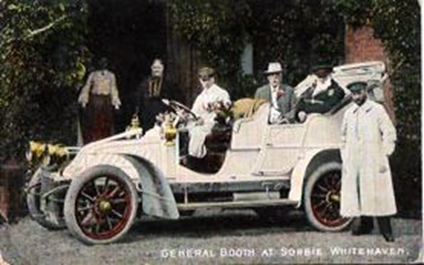
Things had changed radically when, just over 20 years later, in 1909, General Booth visited Ripley on one of his motor tours, his distinctive white car greeted with fulsome ceremony by all the great and good of the town, headed by the members of the Local Board’s successor, Ripley Urban District Council.
Among the welcoming party was Marshall Hooper.
The Hall was built in 1911, the dedication stones being laid on June 10th. There were two, one laid by William Smith JP and the other by Councillor Henry Stanley. Stanley was a Baptist and Smith a Wesleyan and teetotaller; neither were directly connected with the Army, though they were both Liberals and very influential men in local politics.
A Young People’s Hall added in 1914.