
The Butterley estate was also owned by the monks of Darley Abbey until the Dissolution of the monasteries in 1538. There seems to have been a medieval manor house there, as well as known coal deposits. There is a suggestion that there might also have been a chapel, but there is little evidence for this claim. (This is where the inspiration for the monk statue at the entrance to the police headquarters comes from.)
The estate was granted with that of Pentrich to Sir William Cavendish (1505-1557), who was a “visitor of the monasteries”, one of Thomas Cromwell’s men who assessed the value of the religious institutions, and who later married Bess of Hardwick, his son becoming the first Duke of Devonshire.
The estate was probably originally a hunting park, but had already become known as a source of income from the coal deposits under the land.
He seems to have quickly sold the Manor House and estate to Sir John Zouche of Codnor who was keen to exploit the mineral wealth of area. In 1617, he sold the manor of Ripley, “except the mansion house called Butterley Hall and Butterley park” to James Wright and Robert Wilde. However, Zouche overextended himself, and in 1621 sold Butterley to Matthew Bate of Derby, who later sold it to John Spateman, a parliamentarian who supported Sir John Gell.
The Hall seems to have been rented out, but in 1661, one Baptist Trott leased the estate to Edmund Horne of West Hallam. A few years later, in 1669, Horne bought the estate.
Edmund Horne died in 1673 and his son William inherited the estate, becoming one of the Lords of the Manor of the area. He was probably responsible for the first of several buildings or rebuildings of the house. It was this William who is reputed to have lived to the age of 102, dying in 1747. He had a reputation as a scholar, and sent his sons to Repton School. He and his wife Barbara had at least six children.
The eldest son, William Andrew, inherited the estate and apparently rebuilt the house around 1750. He it was who became one of the most infamous characters in Ripley’s history. A spoilt heir, he gained a reputation as a rake, and there were at least two bastardy claims against him. It seems, however, that he also had a child by one of his sisters in 1724, and colluded with his brother Charles to have the child carried away and left to die in a hayrick in Annesley.
He seemed to have got away with the crime, but 35 years later, his brother Charles, who felt he was badly treated by his brother, finally informed against him. Horne was unpopular in the area, and there were soon others who were prepared to bear witness against him. He was taken into custody: he was said to have hidden in a chest but been discovered.
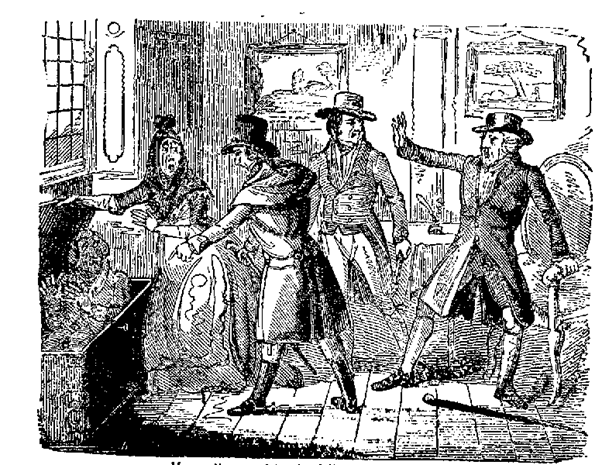
He was convicted of murder and hanged at Nottingham jail on 11th December 1759.
His story became a popular broadsheet and was reprinted many times over the following 200 years, often with sub-titles like “the Penalty of Sin Delayed, but Certain.” The full transcript of the trial was again published in 2010, and is now available online as part of the Wellcome Collection.
The story continued to surface for many years after : there was a newspaper article claiming his ghost haunted the hall in 1980.
The estate was inherited by Edmund Horne, a captain in the Royal Navy. He had command of the Bomb ship HMS Serpent in 1742 and later captained the fourth-rate ship of the line HMS Rupert. He died childless in 1764, leaving his estate to a cousin, Talbot Williamson. The cousin died shortly afterwards, and it seems that the estate then finally came to Charles Horne (the informant’s younger brother) who continued to live at Butterley Hall until his death in 1784. He seems to have commissioned a plan of the estate when he inherited it in 1766, and he probably partly rebuilt the house again.
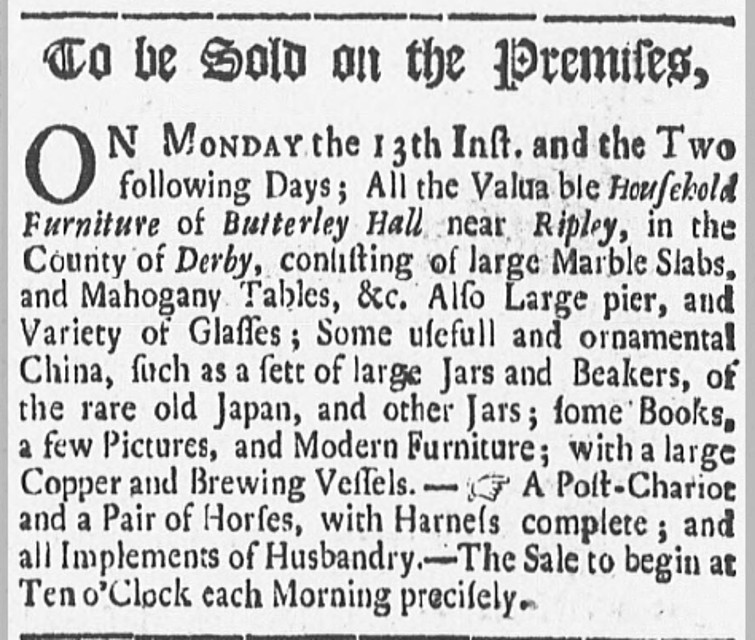
He certainly sold off its contents in 1769. (The bill of sale is shown here.)
On his death, the estate then passed to a nephew, Edward Warren, who took the name Horne. He’s the one who appears on Burdett’s map of the area. He let the house in 1782, the letting agent being none other than Joseph Outram, Benjamin’s father.
Horne sold the house and estate to Francis Beresford and Benjamin Outram in 1790, and Outram rebuilt the house in its current form in 1793-1800. A later sketch shows what it must have looked like.
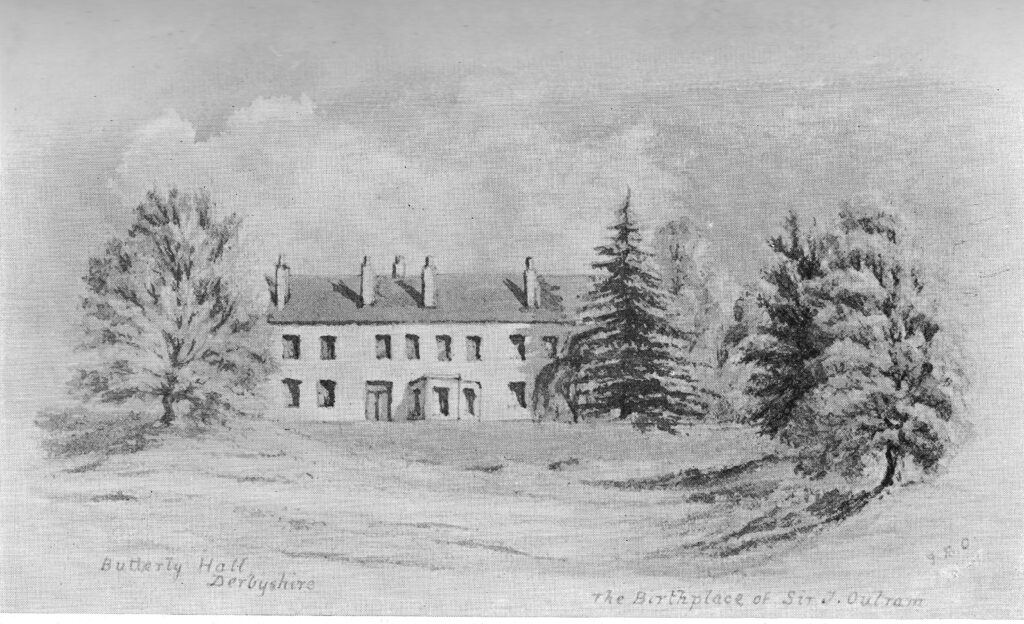
The estate was important to the Butterley Company as it not only provided a suitable grand house for the owner, but the estate also contained coal deposits found when excavating the Butterley tunnel for the Cromford Canal, which was constructed underneath the estate.
Outram died in 1805 and his furnishings were auctioned off to provide some income for his wife Margaret.
William Jessop took over ownership of the house, and it stayed in his family until 1884 when a later William Jessop left Butterley and auctioned off the contents of the house. In the sales details, the house was said to have “21 bedrooms, Entrance Hall, 4 Reception rooms, Billiard-room, Butler’s Pantry, Housekeeper’s-room, Kitchens etc”, and the sale included, among many other items, a “piano-forte”, a “3-tier What-not”, Dresden groups and figures, Oriental bowls, an Indian chess set, oil paintings, 90 bronze medals, a library of 1700 books and 200 dozen bottles of “rare and choice wines”.
Jessop died the following year at Alverstoke, Hampshire. It seems likely that the house passed to the Wright family at this stage, though it was let for a few years to a Mr and Mrs Hollis, after which Albert Leslie Wright (1862-1938), Francis Wright’s grandson, took up residence there in 1889. In 1891 he is listed on the census as living there with his cousin Alfred F Wright, both of them single, and 4 servants. By 1901, A. L. Wright was married with 6 children and 8 servants.
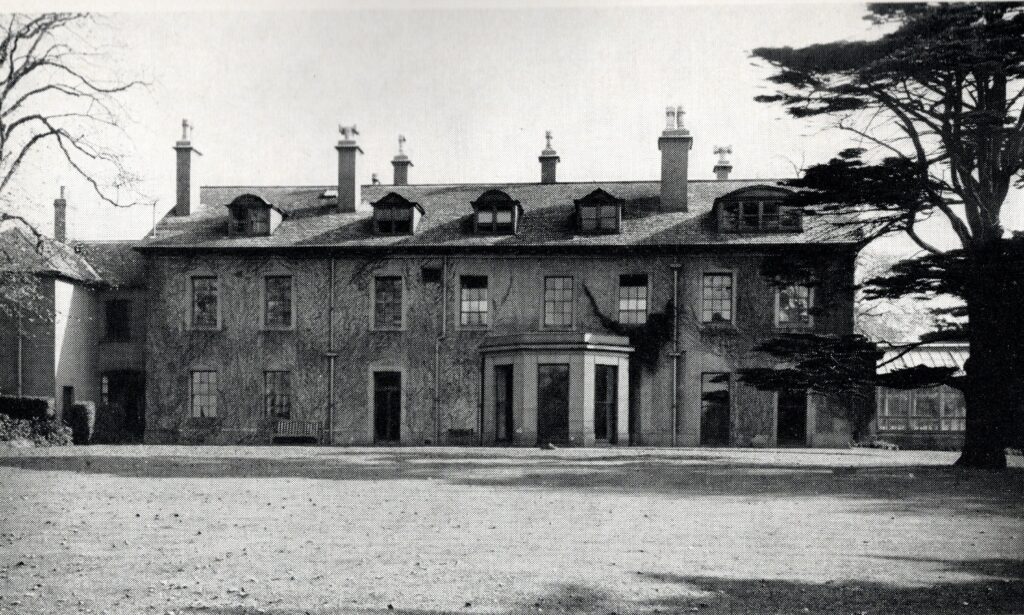
His wife died in 1907, as a result of an accident whilst on holiday in Wales, and Wright remarried to Emily Cecilia Coote in 1909. He continued to live at Butterley Hall until his death in 1938. His son-in-law (and distant relative) Arthur Philip Coote then took up residence and acted the part of Lord of the Manor until just before his death in 1954. In 1953, the hall came back into the possession of the Wright family, who took the decision to turn it into the headquarters of the Butterley Company. During the late 1950s and early 1960s they built several modern office buildings adjacent to the Hall.
Finally, following the takeover of the Butterley Company by the Wiles Group in 1968, the Hall site was sold of “for the bargain price of £150,000” according to Roy Christian, after the contents of the Hall had been auctioned off, “quick disposal being a priority.”
Derbyshire County Council bought the site in order to relocate the County Police Headquarters from Matlock, though the process took until 1977. Since then many new buildings have been built on the site, and the County Fire Service Headquarters joined the Police in 2017.
