
The Horne family seem to have been coalmasters, operating small bell pits initially in the West Hallam area. They were wealthy enough to consider themselves minor gentry.
The Butterley estate was owned by the monks of Darley Abbey until the Dissolution of the monasteries in 1538. There seems to have been a medieval manor house there, as well as known coal deposits. The estate was granted with that of Pentrich to Sir William Cavendish (1505-1557), who was a “visitor of the monasteries”, one of Thomas Cromwell’s men who assessed the value of the religious institutions, and who later married Bess of Hardwick, his son becoming the first Duke of Devonshire.
In 1661, the estate was leased from Baptist Trott by Edmund Horne of West Hallam. A few years later, he bought the estate. There were several generations of Baptist Trotts, the family originally coming from London, but it is likely that this one was a lawyer or agent for the Fitzherberts of Tissington, or possibly the Gell family. Whether the Butterley estate was owned by Trott at the time or by one of the noble families is difficult to say
Edmund Horne died in 1673 and his son William inherited the estate, becoming one of the Lords of the Manor of the area. He was probably responsible for the first of several buildings or rebuildings of the house. It was this William who is reputed to have lived to the age of 102, dying in 1747. He had a reputation as a scholar, and sent his sons to Repton School. He and his wife Barbara had at least six children.
The eldest son, William Andrew, inherited the estate and apparently rebuilt the house around 1750. He it was who became one of the most infamous characters in Ripley’s history. A spoilt heir, he gained a reputation as a rake, and there are at least two bastardly claims against him. It seems, however, that he also had a child by one of his sisters in 1724, and colluded with his brother Charles to have the child carried away and left to die in a hayrick in Annesley.
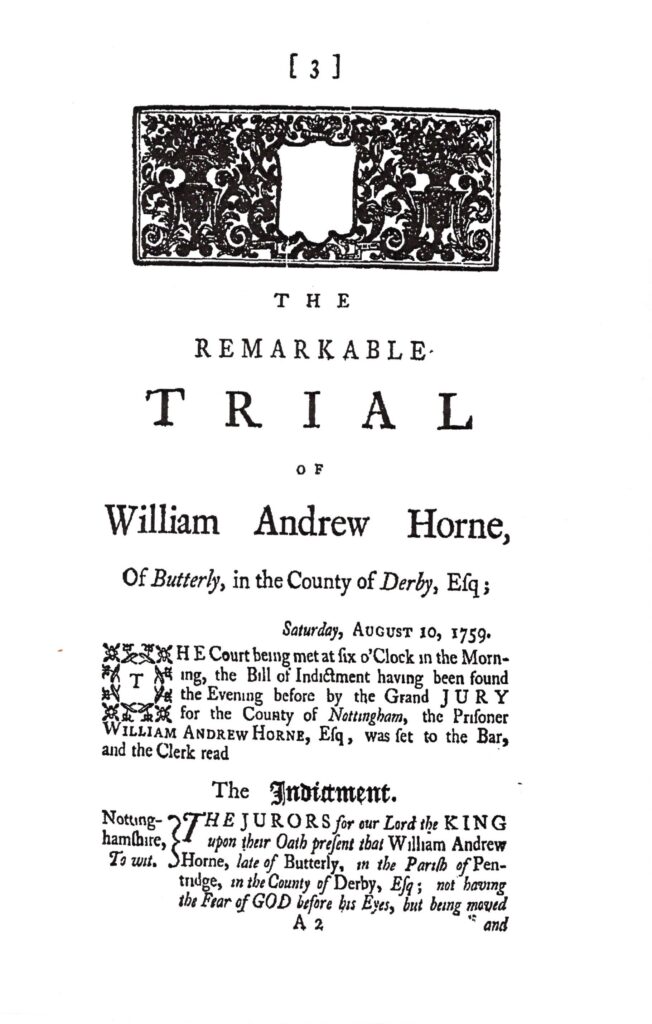
He seemed to have got away with the crime, but 35 years later, his brother Charles, who felt he was badly treated by his brother, finally informed against him. Horne was unpopular in the area, and there were soon others who were prepared to bear witness against him. He was convicted of murder and hanged at Nottingham jail on 11th December 1759.
His story became a popular broadsheet and was reprinted many times over the following 200 years, often with sub-titles like “the Penalty of Sin Delayed, but Certain.” The full transcript of the trial was again published in 2010, and is now available online as part of the Wellcome Collection.
The estate was inherited by his brother Edmund Horne, a captain in the Royal Navy. He had command of the Bomb ship HMS Serpent in 1742 and later captained the fourth-rate ship of the line HMS Rupert.

He died childless in 1764, leaving his estate to a cousin, Talbot Williamson. The cousin died shortly afterwards, and it seems that Charles continued to live at Butterley Hall until his death in 1784. He seems to have commissioned a plan of the estate when he inherited it in 1766.
On his death, the estate then passed to a nephew, Edward Warren, who took the name Horne. He sold the house and estate to Francis Beresford and Benjamin Outram in 1790, and Outram rebuilt the house in its current form in 1793-1800. The estate was important to the Butterley Company as it not only provided a suitable grand house for the owner, but the estate also contained coal deposits found when excavating the Butterley tunnel for the Cromford Canal, which was constructed underneath the estate.

It became the home of successive owners of the company, the Outrams, Jessops and Wrights, before being bought by Derbyshire County Council for the new police headquarters in 1969.