
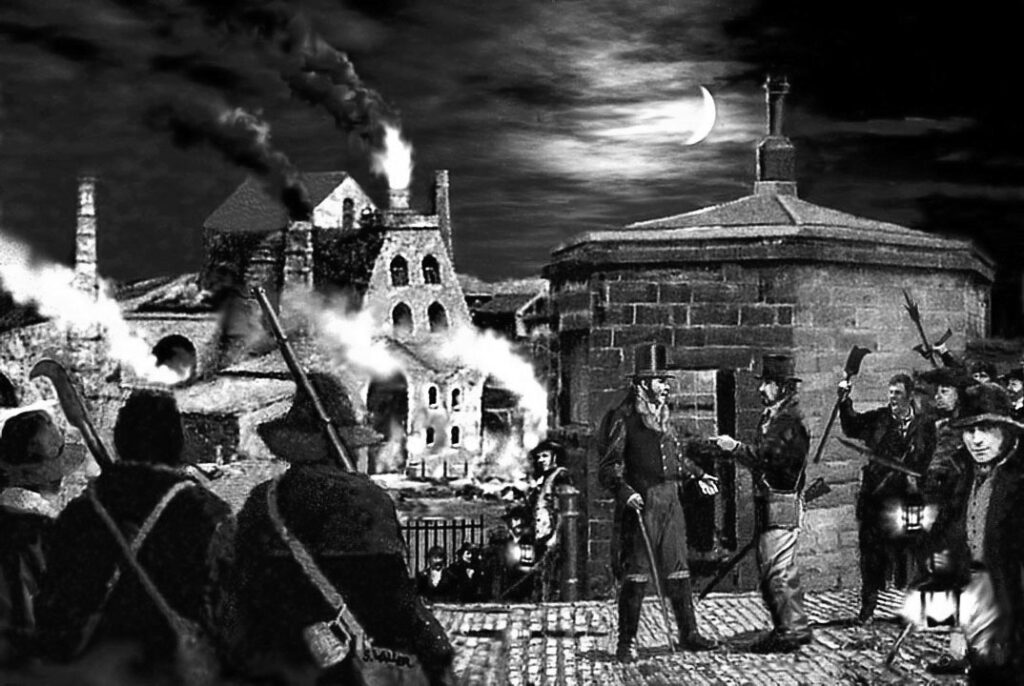
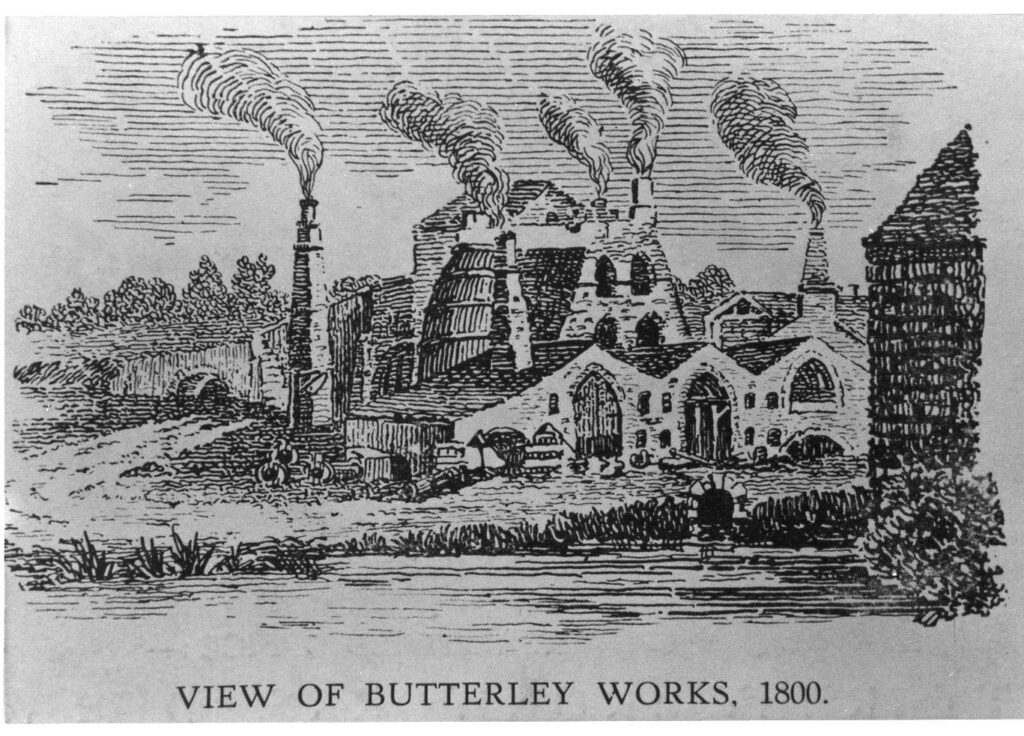
There he is, in Simon Waller’s reconstruction, in a top hat and boots, arguing with Jeremiah Brandreth, the leader of the Pentrich rebels one dark night in June 1817. It is what Goodwin, the manager of the Butterley works, is most remembered for, yet it was only a few minutes out of a lifetime of service to the company.
He was born in South Wingfield in 1777, the son of reasonably well-off yeoman farmer John Goodwin who lived, so it seems, at Ufton Hall, a farmhouse within 100 yards of the Peacock Inn. George would certainly have had an education, but it looks like he joined the Butterley Company soon after it was formed in 1790, in 1795, aged around 18. He would stay there until he died in 1848, aged 71.
In his 53 years there he was known variously as “managing clerk”, “agent” and “manager” and on his death was referred to as “superintendent of the company’s general concerns”. When Jessop or Outram were busy with other projects, he was effectively running the works
Yet there is another side to the man which appears in a document found by his family many years later and published in the Ripley and Heanor News in 1930. It seems to be an indenture, a legal document, but is in fact an elaborate joke.
It purports to be an agreement between three men: Goodwin, Joseph Outram, Butterley founder Benjamin Outram’s younger brother and William Jessop, son of the other Butterley founder and the man to whom the Codnor Park Monument is dedicated. It is dated 1801: Goodwin was 24, Outram 30 and Jessop 18. The three friends were apparently in the habit of drinking together and laying bets between themselves.
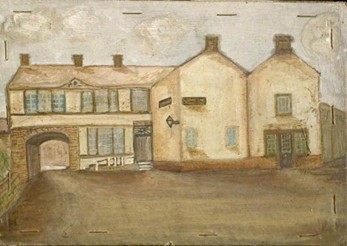
The indenture sets out, in convoluted legalese, that, as Goodwin has won most of the bets, the other two must pay for the next meal: a barrel of oysters and three bottles of wine at the Peacock, a place Goodwin must have regarded as almost home.
In itself, it is an insignificant lads’ prank, but given the subsequent history of the three men it reveals an entirely different view of their lives, and especially of the man who faced down the Pentrich rebels.
As time went on, glimpses of Goodwin appear in the local press. In 1819 he was instrumental in providing Ripley’s first large school in Outram Street, paid for by the Butterley Company and part of the reaction to the Pentrich Revolution which also resulted in the building of All Saints church. Goodwin was on the organising committee for the church and gave £20 towards the building himself, quite a sum for someone without inherited wealth. He was also a trustee of the Cromford to Langley Mill turnpike in 1823, and added his name to a number of petitions published in the press. He had become someone to be taken note of.

At his death, the Derbyshire Courier reported that he “was distinguished for uprightness and strict integrity of character. His death will be deeply lamented alike by his warmly attached employers and a numerous circle of relatives and friends. Wednesday being the day on which his remains were interred at Ripley, the Butterley works were entirely stopped, and all the shops in Ripley closed.”
His will, dated 1845, gave some idea of his life. He never married, but left no fewer than 31 bequests, mostly of £100 (roughly £10,000 today) to the children of his brothers and sisters, as well as to Phoebe Wragg, who seems to have been his housekeeper, her sister and Henry Strafford, who seems to have been his protégé, and who later took on some of his role at Butterley.
He also left his furniture to Phoebe Wragg, noting that “a considerable part of the furniture in the house being her own”, and left her an annuity of £25 per year “in consideration of the care and attention I have for my years received from” her. He left her half his books; the other half, together with his watch, seals and clothes and his portrait painted by Thomas Barber he left to his nephew George Goodwin of Langar.
Although not in a conventional marriage, he clearly developed a strong relationship with Phoebe, and was extremely generous to his family.