
The first law enforcement officers were the constables and headborrows established by the Statute of Winchester in 1285. They were unpaid, appointed by the parish each year, along with the overseer of the poor, overseer of the highways and church wardens. Although there are no records extant, since Ripley had a fair charter from 1251, it is likely that it also had a constable.

The Pentrich Parish Registers begin in 1665, and the accounts allow us to identify some of the constables from that time, including some women. According to “A History of Ripley”, in 1696 one Rosamon Walker, an alewife, was made constable, and in 1699 Mary Eyre was elected headborrow. Both had to employ a scribe to complete their accounts.
The first task of a newly selected constable was to travel to Denby or Derby to swear their oath in front of a magistrate. They had to visit the Quarter Sessions four times a year, held at Derby, Bakewell, Chesterfield and Wirksworth in turn. The constable, as well as arresting villains, had to levy the County Rate, which paid for, among other things, contributions to the County Jail, Houses of Correction, and the King’s Bench and Marshalsea prisons in London. It also contributed to the upkeep of bridges throughout the county.
The W.I History gives a list of some of the misdemeanours which the constables had to deal with : “selling of ale without a licence, neglecting watch and ward, giving shelter to rogues and beggars, not serving time of apprenticeship, refusing to mend the highways when ordered by the constable, keeping greyhounds and guns without licence, assault and battery, obstruction and nuisance on the highway, not repairing the stocks, befouling a common well, pound breaking, working at trades without serving an apprenticeship, and turning diseased animals on to the common thereby infecting other people’s animals.”
The Constables and Headborrows also had to deal with accidents, as this extract from Headborrow John Warney’s accounts book in 1689 shows: “Spent upon a poor woman that fell in a well at Greenhillocks, paid to Grace Wood 4s 6d ; paid to Katherine Gregory for laying (out) ye said woman 2s 6d.”
These medieval arrangements continued into the nineteenth century, although Ripley grew very rapidly once the Butterley Company was established in 1790. In the first half of that century there was effectively no police force, although officers and sometimes detectives were brought in from Derby and Chesterfield at times like the fair days.

Although English counties and boroughs were allowed to set up their own police forces by Act of Parliament in 1835, Derbyshire did not, with the exception of Derby City and Chesterfield which established forces in 1836. The 1850 Parish Constables Act allowed magistrates to appoint superintendents who would be in charge of the Parish Constables and the lock-ups, and Derbyshire did make use of this Act, but It was not until the 1856 County and Borough Police Act that more rural areas were mandated to set up police forces.
Derbyshire Constabulary was thereby formed in March 1857 with the strength of 156 men. At this time there were eight divisions: Ashbourne, Bakewell, Belper, Chesterfield, Derby, Glossop, Melbourne and Matlock. The Ripley force had two men. Among the first was William Mosley. He was born in Bolsover, the son of a framework knitter and must have been in his late 20s when appointed. He rose to the rank of Inspector, Ripley’s first, before leaving the force in the late 1870s (possibly after a vicious assault upon him in 1876) and becoming a travelling salesman, dying in 1899 in Ilkeston.
It is possible that Mosley Street, originally Red Lion Alley, was named after him in 1869, the police station being built there in the late 1860s, lasting until 2006.
Among the other early members of the force were several Irishmen, including Edward Brady who is listed as a sergeant in the 1861 census, and James Grace Moran, mentioned in 1859 as a sergeant in Ripley. He later became an Inspector in Darley. Though it might seem odd that men were recruited from Ireland, the Irish police had been set up much earlier, by Sir Robert Peel in 1814. They therefore provided a source of trained experienced men when there were few in England. Derbyshire’s first Chief Constable, Willoughby Fox, was also appointed from the Irish Constabulary.
Promotion in those early days could be rapid, as was the case with James Shaw, who was a constable in 1857, sergeant the same year and by 1859 was a superintendent, initially in Chapel-en-le-Frith, but later bringing cases to court in Ripley.
Up until 1866, minor cases were tried at the Smalley Petty Sessions, but in April 1866 there was a well attended meeting in Ripley with the aim of petitioning for the establishment of a Sessions in Ripley to replace that in Smalley. Heanor and Ilkeston were taking similar steps to establish courts. Things moved quickly and by June 1866, local newspapers were carrying reports of the Ripley Petty Sessions, the magistrates being the usual landowners like Fitzherbert Wright and William Jessop.
By 1869 the Petty Sessions had been replaced by Police Courts who dealt with the same kind of offences. In Ripley’s case this was mainly drunkenness and poaching; any more serious charges were usually referred to the Quarter Sessions in Derby. In the period 1840 to 1890, part of the fines imposed for drunkenness or assaults on police went to police officers’ pension funds, to which was added from 1872 half of the fines collected from offences under the Licencing Act. This might help to explain why so many landlords were prosecuted for offences like selling ale out of hours.
However, under the Riot Damages Act of 1886, the police had to pay for any damage caused in a riot, the argument being that they should have stopped it!
The 1888 Local Government Act established County Councils, and put the administration of the police in the hands of a Standing Joint Committee composed equally of magistrates and county councillors.
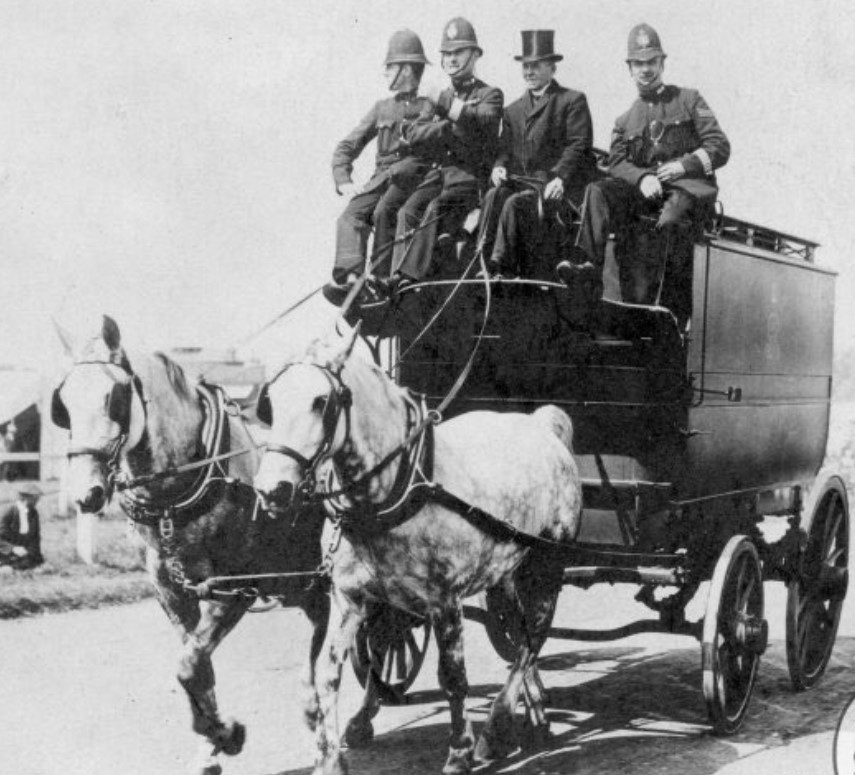
Until 1910, policemen worked 7 days a week; an Act of Parliament in that year gave them one day off a week, only for the provision to be suspended during World War 1. Also during the First World War, women volunteer police services were formed, and the Womens Police Service created; after the war some police services took on these women as constables, initially mainly to interview women and children.
Chesterfield Borough Police was the first local force to appoint a woman as a PC, in 1925, but it took until 1950 for a woman to become a sergeant, also in Chesterfield.
Although the first motor vehicles appeared around 1900, it wasn’t until 1931 that Derbyshire introduced police motor patrols, using motorcycles and sidecars and later Austin and MG sports cars. Some of the Austins were the rare Austin Ripley model!
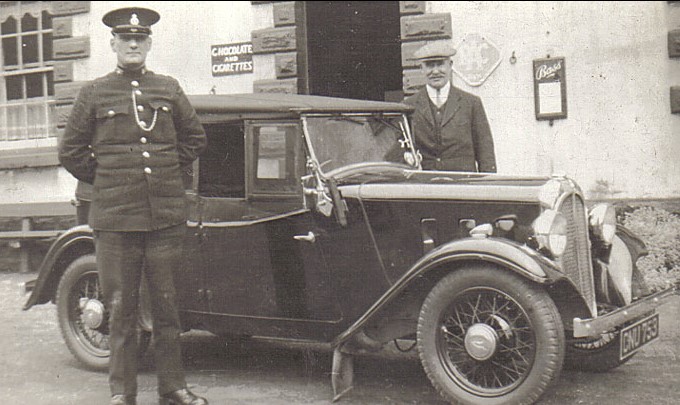
The force headquarters were originally in Derby, but moved to Matlock in 1958 and then, with the purchase of Butterley Hall, to Ripley in 1970. By then, Derbyshire had a county-wide force, Chesterfield and Glossop having merged with Derbyshire in 1947, and the County and City of Derby forces having amalgamated in 1967.