
Dhunjibhai Furdinji Mullan-Feroze was born in Bombay (his date of birth varies from 1874 to 1883, according to the source) and trained in Bombay (qualified 1904) and Glasgow then Edinburgh (qualified 1905). He also seems to have taken a qualification in midwifery from the Rotunda maternity hospital in Dublin. He was admitted to the medical register in 1906.
He seems to have started work as a doctor in various collieries: probably the least well paid medical job available. In 1911 he was surgeon’s assistant (not a surgeon, although he was well qualified) in Ogmore, Glamorgan, working no doubt in one of the Rhondda Valley pits. By the following year, he was in Yorkshire, as doctor at Denaby Pit. It was whilst he was there that he helped in the rescue efforts at the disaster at the neighbouring Cadeby Main pit, when 38 men were killed in an explosion, and a further 53 of the rescue party died as gas in the mine ignited.
Together with another local doctor, the local vicar and 14 of the rescuers, he was awarded the silver life-saving medal of the Order of St John of Jerusalem, and was presented with the medal by King George V at a ceremony at Buckingham Palace on Tuesday 16th December 1913.
By this time, he had moved to Leek where he seems to have joined a practice in some capacity. He didn’t stay long, however. Moving to Ripley in February 1915. He entered into a partnership with Dr Hall, who had in turn been Dr Marshall Hooper’s junior partner. Hooper had died in 1913. The terms of the partnership, confirmed in an indenture, show that Dr Feroze paid a high price for finally getting a foot on the General Practice ladder: he paid £500 down and £550 over the next 4 years: the equivalent of about £65000 today. He also committed to a partnership of 20 years, though in the event Dr Hall left Ripley around 1918 and died in Lichfield in 1920.
Dr Feroze settled in the town, and was successful enough to join the Freemason’s Okeover Lodge in 1917. He was Worshipful Master in 1926 and Chair in 1929. He was the Clarke’s family doctor, and through Ada Clarke, got to know and was liked by D.H.Lawrence. Lawrence refers to him as a “Parsi”, that is, a Zoroastrian. He treated Lawrence for the flu in 1919. He apparently figures in “Aaron’s Rod”, written in 1922, as Dr Sherardy. The picture below shows him with DHL in 1918.
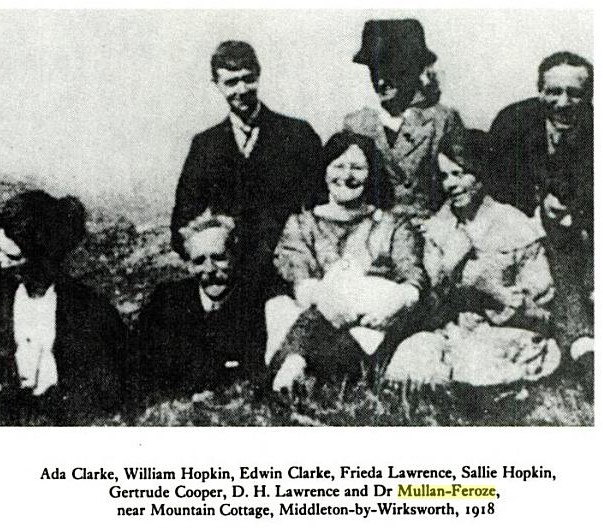
By 1917, he is settled in to the routine of a doctor in an industrial town : private patients, certainly, but also treating the numerous accidents at the pits and works, and conducting post-mortems. He was clearly well liked : many obituary notices give particular thanks for his treatment of the sick and dying. He employed a chauffeur (presumably he didn’t drive), though he got into trouble for not paying his National Insurance contributions in 1929.
He married late, in 1932, to the daughter of an Eastwood draper, Ivy Trueman Jordan. He was round about 50, she was 28. The Rotary Club presented him with a “curb and companion set” to mark the occasion. Their son, Michael George, was born a year later on October 6th 1933 at Shirley House which was by then their home and the surgery.
Ivy Mullan-Feroze had been involved in Amateur Dramatics in Eastwood before their marriage, and it seems she continued to be so in Ripley: in 1937, she presented a play at a Missionary Rally. The cast list included the names of Ogle, Whitcombe and Wain; in other words, she was mixing with the well-off middle-class of the town. At a British Legion meeting in March 1939, she is giving recitations; Mrs Wain J.P. was the chair and Mrs Clarke President of the Branch.
By the time of the 1939 Register, the family were settled in 16 Shirley Road, with at least one live-in servant. In March 1940 she was present, as District Secretary of the local guides, to welcome Madame Malkowska, the Chief Guide of Poland, who gave a graphic account of the German invasion of her country.
By 1941, Dr Feroze was obviously doing fairly well. He was made President of the Rotary Club and was advertising for a “mother’s help”. By the following year, he had an assistant, Dr Govind Raghvendra, and was joining Dr Thompson and others in the hospital Christmas celebrations. On May 9th 1943, his wife gave birth to their second child, Angela; Dr Feroze was about 60 and his wife 40.

He continued to work in Ripley until the mid 1950s. He died in 1959 at the age of 78 or so. In his will he left £3122, the equivalent of about £65000 today
His son, Michael George Mullan-Feroze, was also a doctor and took over the practice in the mid-1950s, working both there and at Ripley Hospital. He trained in Birmingham where he met and married a staff nurse, Patricia A Stockley in 1959 : they had three children: Sally-Ann in 1961, Rebecca J in 1964 and Rachel Elizabeth in 1965. He died at the age of 50 in 1983; his mother outlived him, dying in 1988.