
There were probably some dame schools in Ripley before 1819, but they would have been very small and very basic. In fact, the authors of “A History of Ripley” in 1931 record only one school, that of Samuel Milward, whose school “would be attended by the sons of well-to-do local farmers and squires.” They add that “we hear of no provision of free education till 1819.”
Contrast this with Crich which had three days schools for boys and three for girls, educating about 150 children in total in 1818, or Heage where a charity school had existed since 1705, or Denby where a similar school was founded in 1728. Swanwick and Alfreton also had charity schools.
Partly this is because before 1790 and the coming of the Butterley Company, Ripley was very small, and partly because, as a manor, it had been divided up over the centuries, leaving no one wealthy family as squires, benevolent or otherwise.
The stimulus for a change came in the form of the Pentrich revolt in 1817, together with the wider national unrest after the end of the Napoleonic wars. The former prompted the Duke of Devonshire, who owned most of Pentrich, to demolish the houses of the rebels, and on the site of one of them, Thomas Bacon’s, to build a school in 1819. At the same time, it was recognised that the church at Pentrich was far too small for Ripley’s growing population, and a fund was created to build a chapel of ease at Ripley, which eventually became All Saints church, opened in 1821. Along with the church, a school was built “to afford the labouring classes the means of religious worship and instruction in the principles of the established church.”[1]
The broader national picture was of similar concern that the poor were dangerously disaffected because of lack of the correct education. A Select Committee of parliament had, between 1816 and 1818, commissioned a series of reports on the education of the poor, mainly done by asking the vicar or rector of each parish to report on the number of schools and the number of children educated. Slightly earlier, in 1808, the British and Foreign Schools Society had been set up to promote education of the poor using the Lancastrian or monitorial system. These were largely non-conformist schools, known as British schools. In 1811 an equivalent society, but based on the teachings of the Established church, was set up: these schools were known as National schools.
It was one of these National schools that was set up in Ripley in 1819. The National Society provided some of the funding, as did the Duke of Devonshire, and a substantial amount from the Butterley Company and its owners. The “History of Ripley” again: “a National school was erected at Ripley at a cost of £228, a grant of £100 being made by the National Society; this school stood at the corner of Wood Street.”[2]
Roy Christian in his book “Butterley Brick” notes that the building of this school set off “a demand for education for the less poor. By 1835 Ripley had nine fee-paying day schools, though the fees – and indeed the schools – were probably small.”[3]
There were Sunday Schools before 1819. According to Philip Riden, ”In 1811 there was a Unitarian Chapel in Ripley and a Wesleyan Methodist chapel, to which a Sunday school was attached claiming in 1819 a remarkable 300 pupils.”[4]
In 1842, a Parliamentary Commission into the Employment of children examined managers and children in local pits. At Butterley they found 7-year-old Samuel Godber working on the bank (i.e. above ground). He could read and write, used to go to the National school and attended the church Sunday school. William Gent was also 7 years old and had worked in pits for two years. He attended the Methodist Sunday school but could not spell. The commissioners commented that he was “very ignorant”, hardly surprising when he was working 12 hour days in the pit. He told the commissioner that he “is so tired, wet and dirty when he gets home, that he undresses, gets his supper and is glad when he is in bed.”
The W.I History of Ripley again: “Many boys and girls never attended school at all; others were withdrawn from school too young to have gained much from it. Children were employed by farmers; others were employed in the mines.”
One of the first teachers at the Wood Street National School was Henry Righton (or Wrighton) who seems to have been at the school from 1827, probably until the school was replaced by the Outram Street schools in 1856.
By then, the population was rapidly expanding, and the Butterley Company needed more educated workers. An article in the Derby Mercury says: “Francis Wright, Esq., of Osmaston Manor, one of the partners of the firm, personally supervised the erection and fittings”[5]. He, or the Company, paid for the 3 schools (Boys’, Girls’ and Infants’) at a cost of £2300. They could accommodate 300 children in heated rooms lit by gaslight from the firm’s gasworks, and included teachers houses next to the classrooms. They remained in use until 1914.
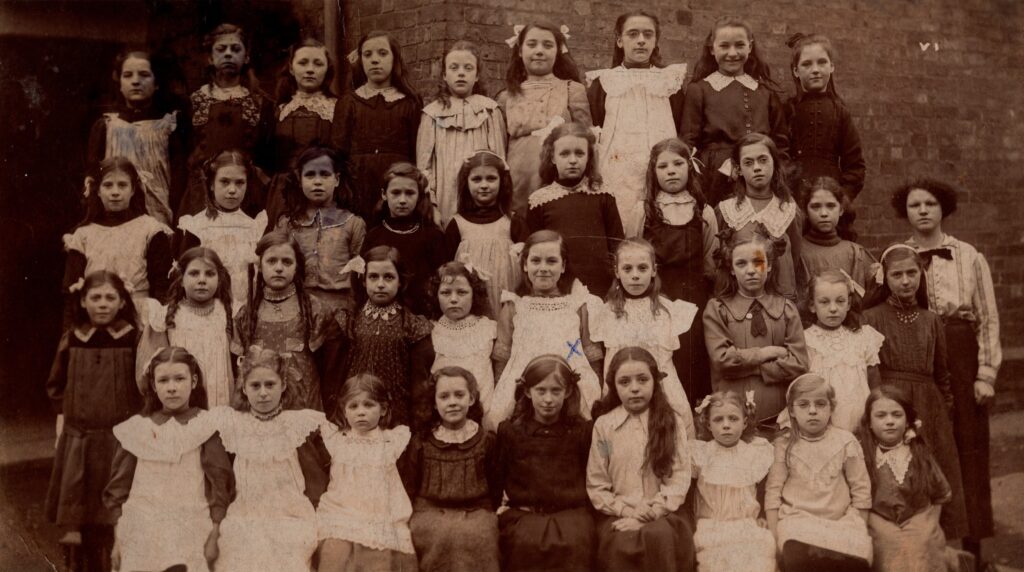
To cope with the expansion of the town, in 1865 a second National school was built at Greenhillocks, along with the associated church, St John’s,
By this time there were also a number of private schools in the town, a few taking small numbers of boarders but others providing an education for the children of the more well-off.
Notable among them were Ripley College on Nottingham Road, run by the Reverend Benjamin Hackett, a Baptist minister and Mary Ann Fletcher’s Seminary for Young Ladies in Greenwich House, also on Nottingham Road. Agnes Slack, who later became an internationally renowned temperance campaigner, attended Mrs Fletcher’s school.
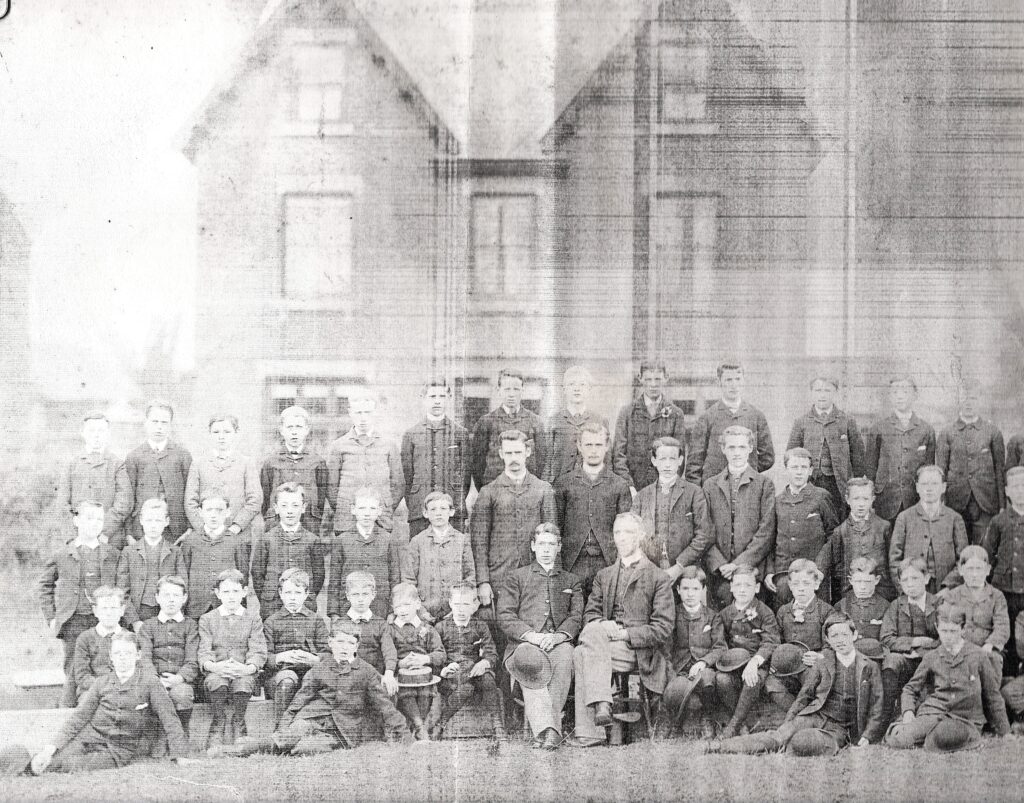
The 1870 Education Act created Local Boards, statutory bodies whose purpose was to provide schools where the National and British schools were lacking. Board schools were established at Hartshay in 1883 and Street Lane and Waingroves in 1884. The Elementary Education Act of 1876 made education compulsory between the ages of 5 and 10.
In 1915 the Outram Street Schools were replaced by new schools in Shirley Road.(q.v.)
[1] Derby Mercury 3rd June 1819
[2] “A History of Ripley” page 148
[3] “Butterley Brick” page 73
[4] Philip Riden, “The Butterley Company 1790-1830” page 104
[5] Derby Mercury 9th April 1856