
Malthouse Yard was one of a number of yards in Ripley, groups of small houses clustered round an open area off the main street. They often had a communal privy, washhouse, cesspit and well. In the case of Malthouse Yard, there was also the malthouse, a corn mill, a brickyard, and later other industrial premises opening off the Yard.
The first use of the land seems to have been as a brewery, for the Fletcher brothers, recorded as being in existence in 1808. By 1821 it had been joined by Robeert Whysall’s malthouse. The Pear Tree Inn, facing on to High Street at the entrance to the Yard, is first mentioned in 1866 when Levi Hawley was granted a licence, and may well have been the original malthouse premises, as Robert Whysall seems to have sold the brickyard and his farming equipment in the early 1860s.
It is difficult to be sure when the two rows of houses were built, but it was likely to have been in the 1830s or 1840s. A breakaway group of Methodists met in a room in the Yard in 1849 prior to establishing a church a few years later. Malthouse Yard itself is first mentioned in the census in 1851.
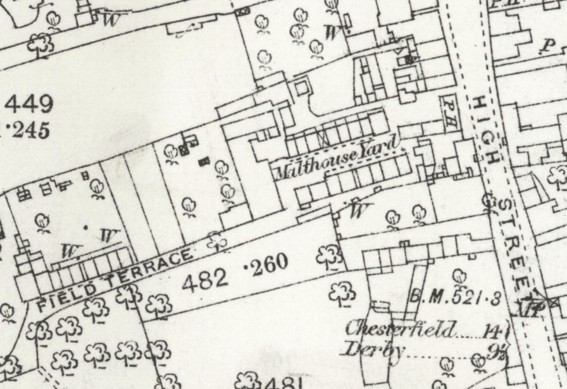
One oddity is that, in the 1871 census there were 32 households listed as being in Malthouse Yard, whilst there seem to have been only 16 houses: 2 rows of eight facing each other. Probably the census included the houses in Field Terrace further down the Yard.
The houses were small – probably two up, two down – and very likely insanitary from their construction. For the next 130 years or so they were home to a shifting population, mainly miners, and gained a reputation for being one of the roughest areas of town. Even in the 1930s and 1940s parents would advise their children not to go through the Yard at night.
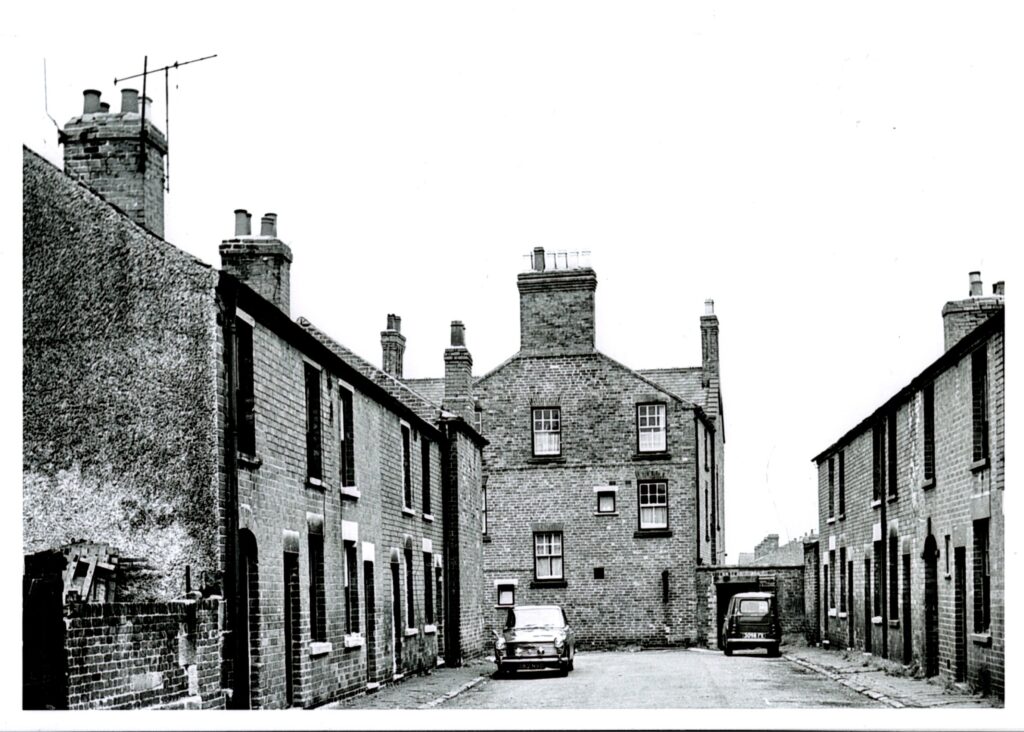
The inhabitants’ behaviour can be traced through newspapers’ crime reports. Drunkenness, illegal gaming, assault, bad language, and theft were common, but there were also prosecutions for cruelty to children, not sending children to school and failing to keep up maintenance payments.
There were also a number of tragic accidents, largely due to the cramped housing conditions. In January 1889 Charlotte Kennell died of burns after her clothes caught fire whilst she was dollying her washing near the fire. In 1900 another woman was burnt when a paraffin lamp exploded.
From early on, concern was expressed about the state of the houses, and the overcrowding in them. In 1889 an anonymous correspondent to the Alfreton Journal reported on a visit to a house in the Yard : “The room which I entered was living-room and sleeping-room. The floor and walls were horribly filthy. The children were compelled to sleep on straw in dirty bacon boxes, and the parents on common planks raised above the floor by means of large furnace cinders..” In 1910, as the Sheffield Daily Telegraph reported, a couple were charged with neglecting their two children. An NSPCC inspector commented that: “the premises were in a filthy condition. The eldest child wore only a shirt and an old skirt and was in an indescribable condition. There was very little furniture in the house..”
By 1933 Ripley Urban District Council agreed to condemn, or refurbish the 16 houses in the Yard. A year later three houses were demolished but the War and then postwar austerity intervened and the other thirteen houses were up for sale in 1949. It wasn’t until 1968 that a clearance order was issued and the houses deemed unfit for human habitation. Finally, in 1971, they were demolished.

Over the years, before it became a car park, the Yard was also the home to large numbers of different trades. As well as Robert Whysall’s brewery and brickyard, there was George Wilson, bill poster and chimney sweep, Ernest Schmidt, German Boot and Shoemaker, Thompson the wheelwright, Joseph Swindell, carter, Thompson the scrap dealer and Harold Blake, motor engineer, which became Daley’s and then Wright’s Garage.
The largest business was the joinery. Frank Mansey tells the story: “George Jackson started a joinery business in 1864, and six years later he employed Samuel Gee as an apprentice. Samuel learned the trade, went away to widen his experience, came back to the Yard and married his boss’s daughter, and became a partner. When Jackson died in 1896 Samuel bought the business, and during the 1914-18 war he won a contract to make ammunition boxes. He employed many of the town’s womenfolk to do this work, built up a small fortune, and developed the business to become the embryo of what grew into a huge national firm, Gee, Walker and Slater Ltd. One of their achievements was the building of County Hall, London, on the banks of the Thames. Samuel died at his Duffield home on 15th March 1935.”