
Thomas Topham was born in Ripley around 1799 to a family who can be traced back to at least the 17th century in the area. One brother, John Cowper Topham, was a grocer in Belper, another, James Jerome Topham, was a Wesleyan minister.
Thomas first appears as a grocer and tallow chandler (or candle-maker) in a directory of 1828-9[1] but by 1831 he was listed as a cotton manufacturer.[2] By 1835, or possibly earlier, his factory occupied the site on Derby Road, eventually stretching down Crossley Street to Wellington Street. It must have been fairly small initially : Frank Mansey in his “Guide” describes it in 1835 as “a one-man company employing two men, three women and nineteen girls”[3]. It continued to expand, however, producing candle wicks and also producing its own gas for lighting as well as enough to light some of the town’s streets before the gasworks was built.
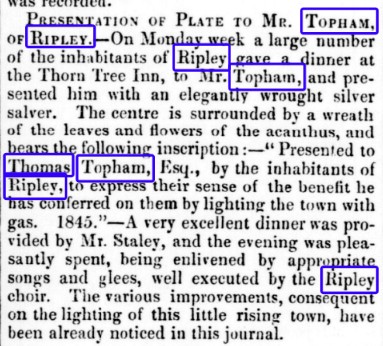
By 1845, the inhabitants of Ripley were so pleased with Topham that they presented him with “an elegantly wrought silver salver” inscribed with the words: “Presented to Thomas Topham, Esq, by the inhabitants of Ripley, to express their sense of benefit he has conferred on them by lighting the town with gas. 1845”[4]
By 1848, Kelly’s Directory commented that: “Mr T. Topham has an extensive establishment for the manufacture of cotton”[5]
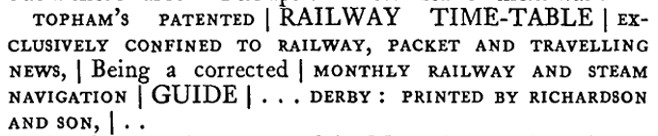
In 1845 he was also on the committee for the building of the Leek and Mansfield Railway[6], and his interest in the railway boom caused him to devise a new way of setting out railway timetables using red and black ink and listing “up” and “down” trains. He patented this layout in January 1848[7]. Shortly afterwards, he arranged for its publication, as “Topham’s Patented Railway Time-Table”, published by Richardson and Son, London, Dublin and Derby.
It was not a success; although published several times over the years 1848-1849 (price 6d), it could not compete with the much more comprehensive and well-established Bradshaw’s Guide. In August 1852, he was declared bankrupt, though he had been in difficulties for some time. He was said to owe his printers £936 (at least £75000 in today’s money).
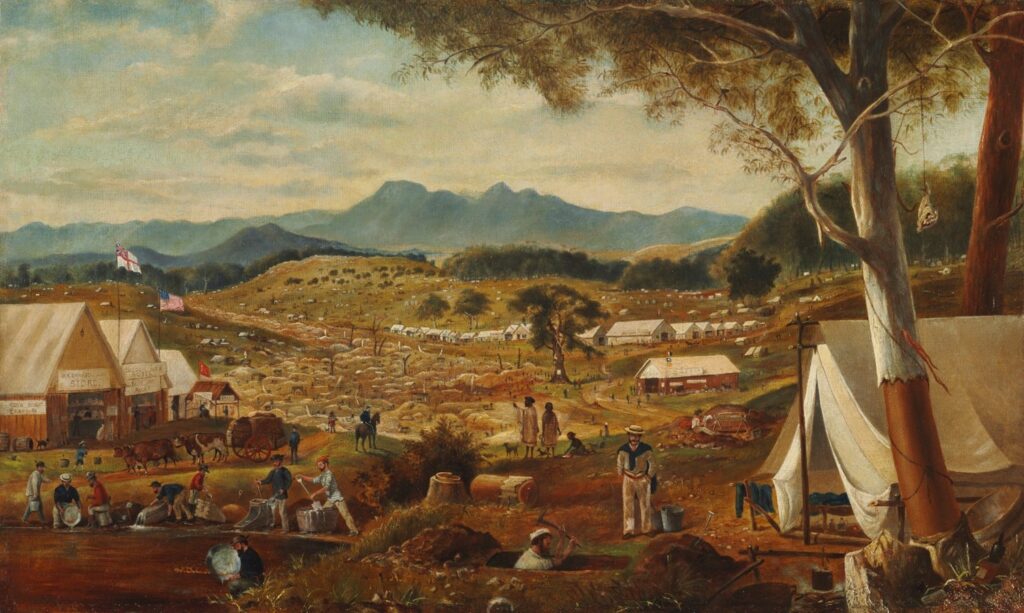
By October that year, the bankruptcy was proved in his absence, and he was declared outlaw, the penalty for not appearing being transportation to Australia for 7 years. Ironically, he had already taken his family and sailed for Australia, to the “Diggings”, or the Gold Rush, clearly hoping to make some fast cash.
It was at this point that James Crossley took over the factory: it’s possible that the families knew each other from London, which was where Topham was living with his second wife, 5 children, a governess and 3 servants in the 1851 census.[8]
Crossley’s lasted until 1903, when it merged with a rival, and the factory remained in some form, as the Ripley Manufacturing Company, until the early 1970s.
Whether Topham made money in the Gold Rush seems unlikely, but what we do know is that he stayed in Australia, dying in 1875 in Burwood, New South Wales aged 76.[9] His second wife Catherine died a year later at the same address.
[1] Pigot’s Directory of Belper and district 1828-9.
[2] Pigot’s Directory of Butterley etc 1831
[3] Frank Mansey, Guide to Ripley’s Heritage, South.
[4] Derbyshire Courier 27th December 1845
[5] Kelly’s Directory of Derbyshire 1848
[6] Herapath’s Railway Journal 15th October 1845
[7] Manchester and Salford Advertiser 5th February 1848
[8] 1851 census Wynyaw House, Farm Lane, Fulham, Kensington, London
[9] Australian and New Zealand Gazette 5th February 1876