
On leaving school in 1920, Ronald Horton had an unusual gap year: he and a friend set up a dog training act and toured Europe with the Royal Italian Circus. Training animals, travelling and recording what he saw became part of his life.
Around 1923, the Butterley Company first used him as one of its sales managers. He was only 21 but his family had had a bolt and hub manufacturing business in Birmingham, and he had invested in firms that sold Butterley iron and coal. By 1939, he was listed as “Commercial Manager Coal and Iron Company” for Butterley and was living in Ironville. Throughout the interwar years, he travelled Europe selling Butterley products.
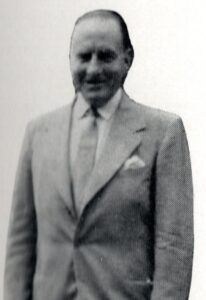
However, that wasn’t all he did: he was also gathering intelligence on German industry and preparations for war. Later, in 1941, he was involved in undercover missions, one of which involved flying in a captured German Heinkel floatplane to Yugoslavia to meet with partisans and supply them with radio sets.

On another mission in France, Horton’s friend, Paul Charnaud, who as a young man had worked with Horton in the circus and who by then was working with the French Underground, was killed whilst meeting Horton who had landed in the floatplane off the coast.
The pilot of the plane was another of Horton’s friends, Bernard Cregg, later painted by the artist Edward Seago; Horton befriended him too and eventually built up a collection of his work. He also recruited Seago as a spy!

After the war, Horton gave up his work for Butterley (and MI6) and settled in Oxfordshire as a horse trainer. In partnership with the jockey Derek Ancil, he had 84 winners in 11 years.
When he died in 1963, the Butterley magazine described him as “a man who made, and held, friendships by his charm and integrity.”