
In 1577 it was reported that Ripley and Pentrich had 10 alehouses (in what must have been very small places), most of which would brew their own beer. In the early 1700s, Charles Horne ran an alehouse at the gates of Butterley Hall, then owned by his family. There was also a brewery, as the name indicated, in Malthouse Yard.

In the nineteenth century, though, there was one, or at times two, commercial breweries in the town, variously known as Ripley Old Brewery, Greenwich Brewery or Queens Brewery. It was probably started around 1807 by John Fletcher, and carried on by his sons, (one of whom, William Henry, was also one of Ripley’s first doctors), and later by his grandsons.
They seem to have run the Red Lion at that time, and it was extensively rebuilt in 1810, providing: “stabling for 20 horses, two coach houses, three parlours at the front with bar, wash-house, brewhouse and pantry in the rear, whilst upstairs could be found a large assembly room 30 feet long and 17½ feet wide with a temporary gallery and 6 lodging rooms and on the next floor, another 3 lodging rooms. A spacious yard was also accessible from the street”.
In 1814 they let the Red Lion and became “common brewers”, selling their beer to pubs rather than running a pub themselves.
The brewery was then situated on either side of Cromford Road, just behind the Market Place, where Amber Valley’s offices and car park are. At one time there was a tunnel underneath the road, so that the malt could be carried from the malthouse on one side to the brewery on the other without getting wet.
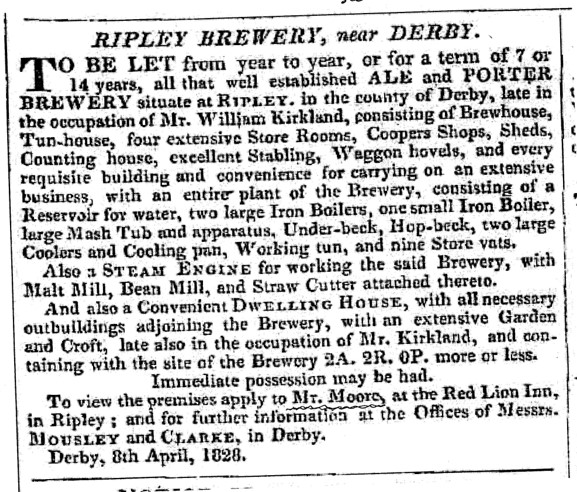
The Fletchers sold the business in 1822 to their partner, William Kirkland, John Fletcher having moved to a new brewery at Cavendish Bridge and William Fletcher to buildings behind the newly built Greenwich House (now Zycomm). Kirkland went bankrupt in 1827, prompting a sale of all the goods belonging to the brewery and the old brewery itself was advertised to let in the Derby Mercury of 8 April 1828. The advert gives a full description of it:
It seems to have been let back to W H Fletcher, but he too went bankrupt in 1830 and the brewery was up for sale again in February 1830, though whether it sold or not is doubtful. By 1839 the brewery was again up for sale, together with houses and land surrounding it.
In 1840 John Fletcher, William Henry’s brother, was also selling his brewery at Cavendish Bridge.
The Cromford Road premises seem to have been hardly used until 1877 when they were rebuilt by John Woolley and reopened, but then offered for sale in 1881, together with three newly-built cottages, a family house and the Windmill Pub on Peasehill, all by then owned by Smiths Bank in Derby. For some reason the brewery continued to be worked but was for sale yet again in 1884 and finally closed in 1888.
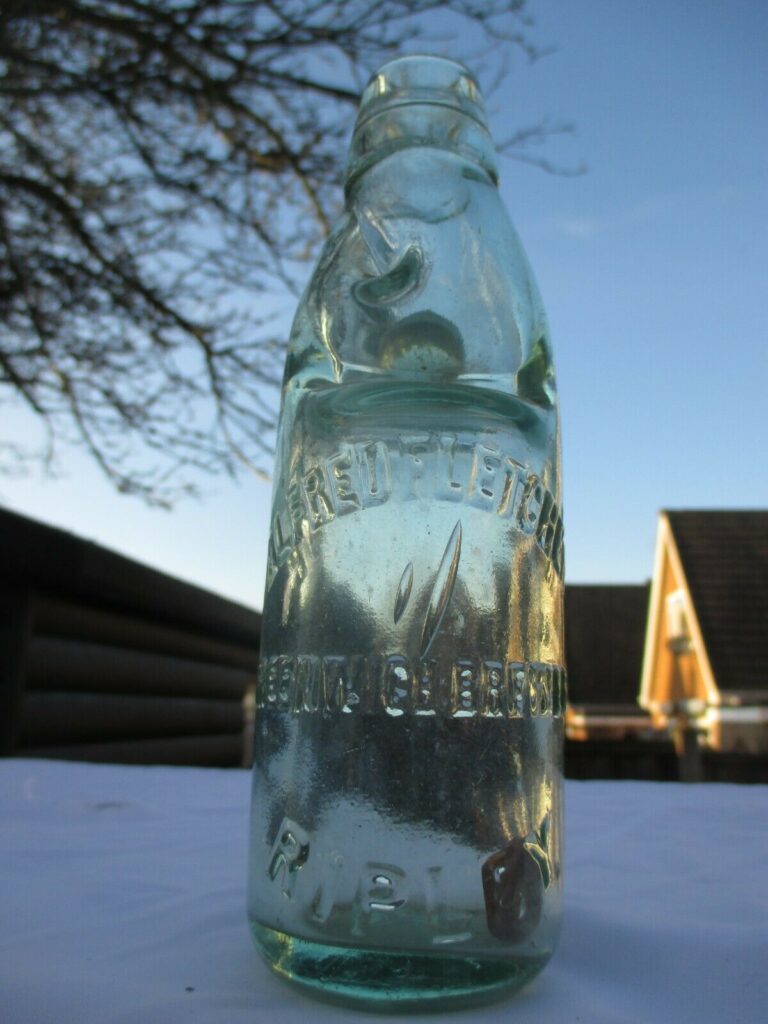
Meanwhile, the Fletchers were brewing at Cavendish Bridge, and at the Greenwich brewery at the back of Greenwich House on Nottingham Road. The latter seems to have been sold around 1880 to Henry Wagstaff who renamed it the Queens Brewery; however, brewing was clearly a precarious business and he also went bankrupt in 1883 and the brewery was once again up for sale.
In 1897 the Smedley family bought the Greenwich brewery premises to produce mineral waters, though they moved back to Cromford Road in 1914. After Ernald Smedley’s death in 1915, the family gave up the business and in January 1916, all the fittings and equipment in the factory were auctioned off. They included engines, bottling machines, a syrup plant, three dray carts and “Mary” and “Robber”, two dray horses.

Greenwich House itself was sold in 1918.