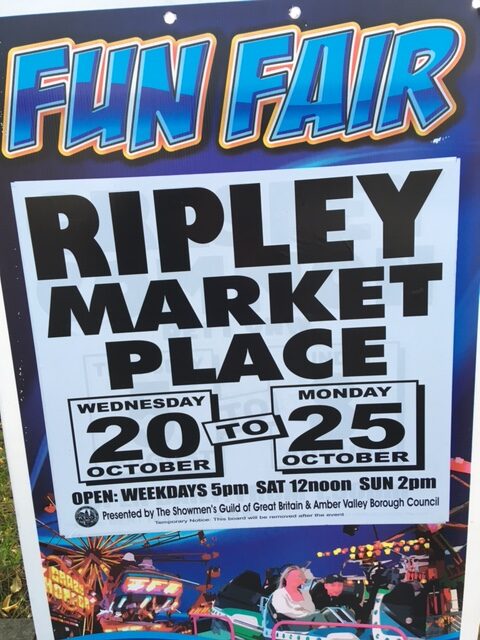
In 1251, King Henry III granted a charter permitting a market each Wednesday in Ripley and an annual fair on the 17th, 18th and 19th August.
The fair, according to Frank Mansey’s summary, was “a commercial occasion, with travelling merchants bringing their wares, better quality materials and garments, spices and wines, salts, jewellery etc from places outside the local area. The event inevitably attracted the street performers of the day, the jugglers, acrobats, musicians, performing animals, dentists and quack-doctors with cure-alls.”
Pigot’s Directory of 1828 reported that Ripley “has two fairs in the year, viz, Wednesday in Easter Week & 23rd October, for horses, horned cattle and pedlary.” The Easter one can’t have lasted much after this date.
The fair was almost certainly held on the village green, on the site of the present Market Place
The first mention of the fair in the Derby Mercury (founded 1727) was in September 1753:

The fair by then had moved to October. The reason for the notice in the Mercury was that in 1752 England had adopted the Gregorian calendar. The authors of “A History of Ripley” tell the story: “eleven days of the year were missed to make matters right….The Lords of the Manor quarrelled about the date of the fair. Was it to be on October 23rd New Style or on the old October 23rd, which would now be November 2nd?… It was at this point that Belper took advantage of the quarrel and attempted to divert the Fair into its own annual fair.” They published a long advert in the Mercury praising Belper and describing Ripley Green as “such a strait, dirty place that both the breeders of foals and the chapmen” (travelling merchants) “have long been weary of it” and suggesting that the fair should be given up in favour of Belper.
At this point the Lords of the Manor stopped arguing and settled on October 23rd, and Ripley Fair went ahead. Only in 1880 was it decided to hold the fair on the Thursday, Friday and Saturday nearest the 23rd.
The Horse Fair
It was largely a horse and animal fair, with a reputation for being a good fair for foals, attracting dealers from the Peak and Yorkshire, and by the mid 19th century it was reported that “nearly one thousand head of cattle” were shown and that the show of foals was “better and larger than any other fair in Derbyshire.”
Fred Miles in “Ripley Recollections” remembered that : “Grosvenor Road was completely closed off. A series of five bar wooden gates were brought in to provide cattle pens and these totally occupied the street, except for a narrow walkway in the middle. At the end of the day the residents were most pleased when it was over. The mess from the cattle had been roughly cleaned up but the smell lingered for several days.”
The second horse and animal fair on the Wednesday of Easter Week became a show run by the Ripley Agricultural Society, with prizes for the best animal in each class and a public dinner in the Cock Inn. The show didn’t last into the 20th century, however, becoming a poultry and pigeon show in the 1880s.
The Statutes
On the first weekday after the October fair, the annual Statutes, or hiring fair, was held, when farmers would secure the services of farmhands and servants for the following year. Before the 1860s, the hiring fair was held in early November, but the newly elected Local Board moved it to coincide with the Fair. Miss Turner, one of the authors of “A History of Ripley” wrote: “My mother remembers a large family of buxom girls who annually appeared at the hirings and were bound to the next year’s service at some farm by the customary shilling which no doubt soon vanished at the fair.”
The Statutes seem to have been abandoned in the mid-1870s after a vociferous campaign, mainly led by the church, to abolish them as encouraging immorality and profligacy, presumably because servants tended to spend their shilling immediately at the stalls remaining from the fair. However, they continued in other towns, like Ashbourne and Heanor, up to the First World War.
The animal fair, gradually diminishing in size and becoming restricted to horses, went on until the 1930s, eventually being confined to Crossley Street as the Pleasure fair grew and took over the Market Place.
The Expansion of the Pleasure Fair
In the early years of the nineteenth century, the pleasure fair began to gradually change. The impetus for this was the creation of the turnpike roads. Increasingly heavy carts pulled by horses and later by traction engines could travel on these roads, allowing the showmen to move from fair to fair with larger and more complicated rides, shows and other attractions, as well as living wagons for themselves and their families.
The move from individual hawkers and chapmen travelling on foot to whole groups of showpeople following a circuit around the country with caravans of wagons laid the basis for the modern fair.
Extra Attractions at Fair Time
By the 1850s, the pleasure fair was, according to the Mercury: “never before known to be so full, the market-place being literally packed with shows, bazaars, and stalls, every available niche being taken up; some stalls extended their line down the adjoining streets.” The fair also began to attract other entertainments to the town. The same report of 1856 noted that: “on Tuesday the 28th ult., the town was visited by Edmond’s menagerie.”
Other entertainments also timed their visits to coincide with or immediately follow the fair. In 1869 and 1875 there were visits of Holden’s marionettes, an elaborate show featuring string puppets.
The chapels also began to put on evenings of entertainment around the time of the fair, probably as a temperance alternative to the pubs. In 1873, for example, there was an evening of “readings, recitations and musical selections” in the Wesleyan schoolroom., whilst by 1891 there was advertised an Annual Ball in the Town Hall, with Mr Hunt’s Full Quadrille Band leading the dancing from 10pm until 4am.
From 1865 the Ripley fair Races were held “on grounds adjoining the town.” They included the Ripley Town Stakes, the Tradesmen’s Stakes and the Innkeepers’ Stakes: races over about one and a half miles, with cash prizes for the winners.
Wall’s Ghost Show
The period between 1860 and 1914 saw rapid changes in the nature of the Pleasure Fair, largely driven by technological advances. One of the early shows which became well known in the town was Wall’s Ghost Show. Ghost shows were theatrical productions, usually of melodramas, including some adapted versions of Dickens stories. At an appropriate point in the play they projected a “ghostly” image upon a screen, using an angled mirror to cast an image of a well-lit hidden actor, who was underneath the stage, on a screen, so that it appeared that the transparent image was moving.
Later projected images, using the new magic lantern, were added to the mix. In addition, by using actors dressed in black against a black background, disembodied objects could be made to appear to move.
The Cinematograph
The main reason for the demise of the Ghost Show was the coming of the Cinematographs shows. The National Fairground Archive’s website gives the background: “Moving Pictures first appeared on the fairground at the King’s Lynn Mart on 15th February 1897 introduced by Randall Williams. Williams, ‘the King of Showmen’, adapted his Ghost Show at the end of December 1896 in order to introduce the latest novelty into his presentation at the World’s Fair Exhibition in Islington. Within a few months showpeople across the country were exhibiting moving pictures to the fairgoing public.”
This was only a year or so after the first public showing of a moving film to a paying audience, again at the Polytechnic Institute, using the Lumiere brothers’ device, the Cimematographe.
The first time a cinematograph show is reported at Ripley fair is in 1899, when the Ripley and Heanor News reported that : “Several of the oldest showmen visitors to the town are missing, including Wall’s, Collins etc, but their places are taken with more modern exhibitions and amusements which in these days prove more attractive. In the first place on the site usually occupied by the Phantoscope stands Twigdon’s Cinematograph or Living Pictures. Adjoining this is Lawrence’s Electrograph or Electric Wonders.”

The Cinematograph films were, of course, silent and often played to the accompaniment of a piano or small band. They lasted at most ten minutes each and were a mixture of re-enacted old stories (like Maria Marten), reconstructions of contemporary scenes (like the Boer War battles) and films especially taken in the neighbourhood, so that the audience had a chance of seeing themselves or someone they knew. In 1900 Lawrences’s showed a Mitchell and Kenyon film, (which still exists) of workmen leaving Butterley works whilst Twigdon’s had film of women workers leaving Crossley’s mill, the arrival of a train at Ilkeston Station and Boer war scenes. In 1901 films included a football match from the previous week (the films were very quickly produced) and the Oberammergau Passion Play.
By 1909 there were no fewer than 4 cinematograph shows at the fair: Twigdon’s, Lawrence’s, Proctor’s and Holland’s. The craze didn’t last, however: by 1910 a Mr Jeffries had applied to set up a non-touring cinematograph in Heath Road, and by the following year, Ripley’s first permanent cinema, the Empire, opened. The fairground cinematograph could not compete with the cinemas’ bigger capacity, more comfort and better facilities, and the showmen moved on to other attractions.
The Electric Fair
Ever since the fair had moved to October, it must have been extensively lit, and no doubt that was part of the attraction. By the mid-19th century, it was lit by paraffin flares, but as early as the 1880s, electric arc lamps were introduced. Soon, generators were installed on the showmens’ traction engines, so that, as well as lighting, rides could be powered by electricity rather than steam. Swingboats powered by the riders were replaced by roundabouts.
One such ride was Proctor’s Golden Dragons, an advert for which appeared in the Ripley and Heanor news in 1915. (Although there was fair in 1914 and 1915, it was abandoned for the remainder of WW1.)
The Fair Between the Wars
The economic slump of the early 1920s, which resulted in the local pits working 3-day weeks, reduced the fair’s takings to the extent that in 1922 there was a false rumour that the fair was about to be abandoned.
Whilst some attractions like the boxing booth remained popular, new ones appeared like the Loop o’ Plane and the Speedway. Cakewalks were introduced, and the first Dodgems appeared in 1930. The Wall of Death, or the slightly smaller Globe of Death, featured motor cycles or miniature cars roaring horizontally around the steep track. In 1931 Collins’ Death Riders even featured the Fearless Egbert who rode the Wall with a lion in his sidecar!
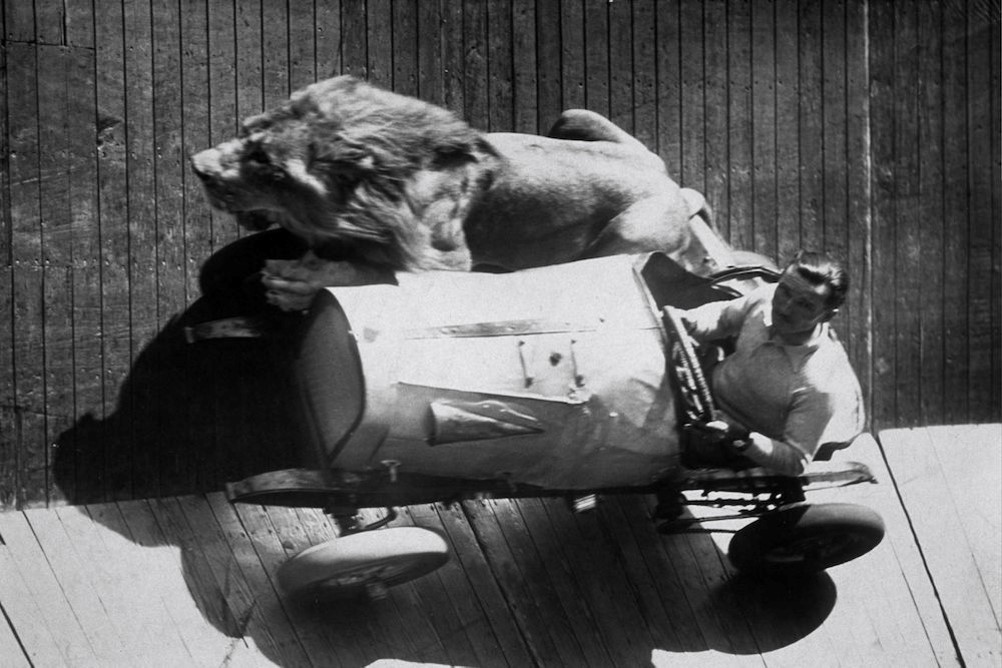
In 1930 the Ripley and Heanor news reported that “one of the most notable absences is Bostock and Wombwells’ menagerie, which has been purchased by the Glasgow Corporation for a municipal zoo”, thus ending a tradition that dated back to 1856.
Gambling Machines
During the 1930s other smaller stalls arrived, creating some controversy. They included The Spinning Peacock, The Automatic Stock Exchange, The Town Broker and others. They were basically games of chance, like large roulette wheels, but often with the names of towns, or football teams, for example, instead of numbers. Punters bought a ticket for 2d with the name of a town or team on it and when the spinner stopped against one the ticket with that name on won the prize. It was a form of lottery.
The stalls themselves were circular and sometimes quite elaborate, with carved figures and animals (like the salvaged peacock shown here) in the centre and on the spinning arm and flashing lights around the perimeter.
And for ten years or so they earned their owners regular visits from the police: under the Gaming Act of 1845 any game that had no element of skill to it was illegal: the punters were, in effect, betting. Some of the games attempted to get round this by providing buttons for each of the participants, supposedly to slow or stop the spinner, though they apparently had no effect at all!
So, each year from 1929 until 1950 (when they were banned by the council), the stallholder would be reported and fined, usually £2 for each occasion. Margaret James of Swadlingcote, for example, was fined every year from 1929 to 1934 for her Spinning Peacock.
Later in the 30s, some stallholders introduced fruit machines, imported from America. These too earned fines. The stallholders came to expect them, and build the costs into their finances.
Quite why Ripley should have been so keen on suppressing the games is a mystery : William Hill in 1931 claimed that he had been running his Spinning Peacock stall for eight years previously “at all the principle fairs between Scotland and Cornwall” without being fined. The stalls were eventually banned at Hull Fair in 1938 and at the Goose Fair in 1947 but the only other local fair where there were fines was at Ilkeston. It may have been a more personal issue: in both Ripley and Ilkeston the charges were brought by the same policemen!
World War 2 and After
The fair was not held during the Second World War: apart from anything else, the lights would have made it a prime target for enemy aircraft. The first post-war fair was in 1945; the only other time it has been cancelled was in 2020 because of the Covid-19 pandemic.
In 1951 the council celebrated the 700th anniversary of the fair’s charter, and in 2001, the 750th.
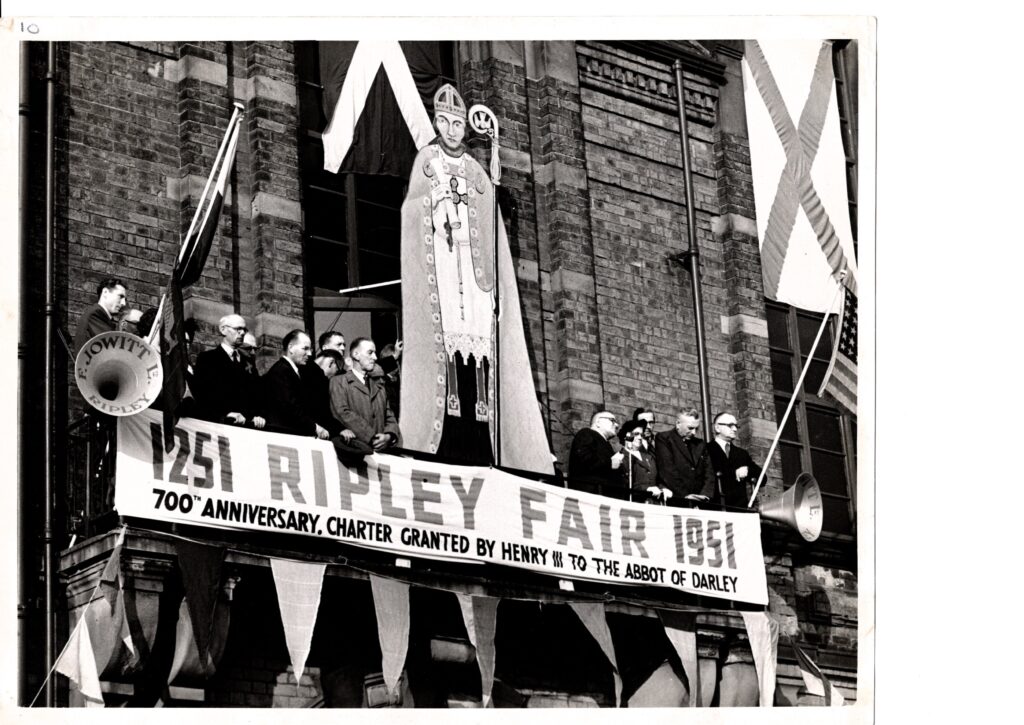
The fair in the immediate post-war period was much like earlier fairs: there were the Big Wheel, Waltzers, Dodgems and Cakewalk, but also a boxing booth and even some animal freakshows, like the World’s Smallest Fox or The Ram with 6 Legs. These gradually disappeared, leaving the increasingly elaborate rides and prize and refreshment stalls that comprise today’s fair.