
A bitter struggle took place in 1893 between British coal owners, who in a response to falling coal prices attempted to cut wages by 25%, and the miners who resisted it. The conflict lasted sixteen weeks and its impact on coalfield communities was devastating, In Ripley, hardships were felt more severely because of the unyielding approach of local colliery owners, particularly the Butterley Company.
As the lockout began, mass meetings were held in all coalfield communities, with miners’ leaders encouraging the men to stand firm. At a meeting in the Co-operative Hall, Ripley, on 17th July, ‘crowded to excess’ and one of the largest held in the town, William Harvey, the Derbyshire Miners Association (DMA) leader, told those assembled that he had never addressed a meeting at a time ‘when there was more anxious thought and grave consideration than at present, when the whole country had turned its attention to the coal trade’.[1] He added that less than 50 men had supported the reduction in Derbyshire, and not a single vote in favour in Ripley. A resolution was passed, proposed by two miners, not to accept strike pay for two weeks after the start of the lockout.
As the weeks rolled by without any sign of a resolution, relief efforts sprang up across the coalfield, with the Ripley and Heanor News reporting on 22nd September that the Miners Relief Fund in the town had distributed 400 food tickets and was helping 176 families each week. The Ripley Co-operative Society took the decision to donate £150 per week via its 12 branches to assist with feeding those in need. By the end of September the Society was helping in the relief of 1,500 people in the area. Nor were miners the only ones affected. Workers in allied trades such as railways and iron foundries were laid off as a result of the lack of coal, and because they were not paid strike money, their suffering was even greater.
Communities elsewhere in the area were galvanised into action. Relief funds were initiated at Waingroves, Codnor, Heanor and Langley Mill, with half a carcass of a bullock donated by a farmer at Denby. Local traders arranged the distribution of bread and soup- Fletcher and Sons of Heanor continued to distribute 14 stones of bread each day, increasing to 28 stones by October, whilst butcher W Hartley donated 20 gallons of soup.
Some coal owners were sympathetic to the plight of the locked out men, particularly Alderman Bayley, owner of Manners Colliery, Ilkeston and Digby Colliery at Giltbrook, and Liberal MP for Chesterfield, who spoke at the Miners Demonstration at Bulwell Forest on August 12th, urging the men to ‘stand firm behind their leaders’.[2] Other proprietors took the opposite stance. Fitzherbert Wright, managing director of the Butterley Company, wrote to the Ripley and Heanor News to ‘clarify’ the proposed cut. The 25% reduction was not 5 shillings in the pound, he argued, rather it was 25% of the 40% advances agreed in 1888-90, leaving wage levels 15% above the 1888 wage. Publicly addressing his letter to Mr Trivett and Mr Rowe, local DMA leaders in the Ripley area, he suggested the reduction amounted to 17-18% of the gross wage, not 25%, and stated: ‘I feel confident that if you could persuade your leaders to drop the ‘No surrender’ cry, but accept a compromise, things might be easily settled’.[3]
In October, the Butterley Company expressed its intention to re-open its pits at a reduction, and instructing those who did not want to resume work on those terms to retrieve their tools from the mines. A huge meeting was called at Ripley, where all the mining population of the town and district were assembled. Intended for the Co-operative Hall, hundreds were unable to get in to the venue, so the meeting re-convened in the Market Place, where DMA Secretary Haslam accused the company of a ‘direct inducement to blacklegism’. The company’s intentions were turned down decisively by those present, but later that month the Butterley Company brought men back to get coal, resulting in a powder keg atmosphere in Ripley.
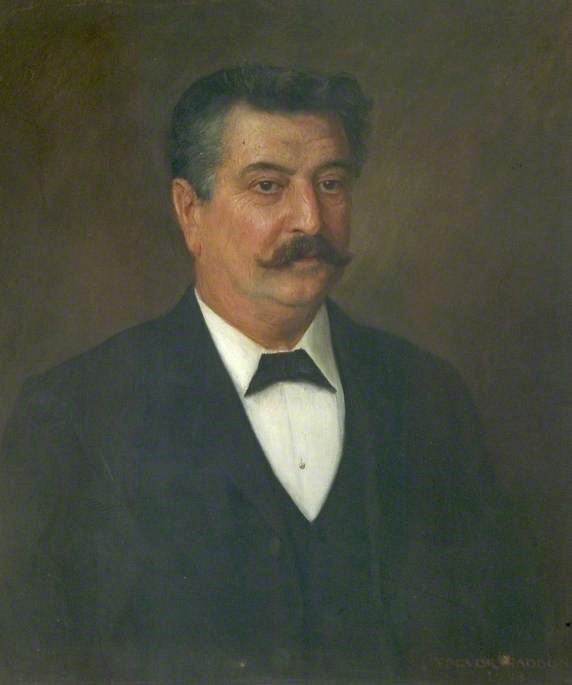
William Harvey, Derbyshire Miners’ Leader
Fuelled by the presence of police and troops, and rumours of blacklegs returning to work, the town became more volatile as the lockout dragged on. A special meeting was called at Ripley Co-operative Hall on 28th October to discuss miners reported to be getting coal at the Butterley Company’s pits in the area. A deputy at Brand’s pit, where soldiers were stationed, had been gathering coal to aid ventilation and the extraction of water, but he had written to the DMA lodge admitting it was wrong. Deputies in other pits had also been asked to ‘scrape together as much loose coal as possible’ in the pits. Harvey, speaking at the meeting, thought this was the devious work of Butterley Company Collieries manager Frederick Channer Corfield. Harvey reiterated the union’s position that deputies should not use a pick or shovel to get coal. By this time some local pits, particularly over the Nottinghamshire border, had resumed work at the old rates of wages, but the Butterley Company remained resolute and would only re-open pits with a wage reduction. Corfield had created tensions between masters and men at Butterley pits, and according to the Ripley and Heanor News, there were ‘unmistakeable signs that disturbances might break out at any time’.[4] The Butterley Company was the largest employer in Derbyshire – as well as the ironworks it owned 23 pits in Derbyshire and 3 in Nottinghamshire. Its miners were among the worst paid in the district.[5]
The Butterley Company had a history of poor industrial relations, resisting the union for many years and only recognising it formally in 1902.[6] A strike in 1874 had led to the victimisation of 11 miners who had taken a prominent role in the dispute. Despite a campaign to have them reinstated, the men were refused employment by the Company.[7] Corfield, founder of the Codnor, Loscoe and Waingroves Conservative Association, was also Lieutenant commander of the Butterley Detachment of the 1st Volunteer Battalion, Derbyshire Regiment (Sherwood Foresters). He was no friend to the unions. The previous year, representing the coal owners, he had given evidence to the Royal Commission on Labour, spelling out their objections to the eight-hour day :
‘Parliament ought not to be asked to legislate for adult labour. The effort of its introduction would be a reduction in output which would raise the price of coal and reduce earnings. The greater hurry consequent upon shorter hours would increase the danger in the mine. The system would lack elasticity, since neither masters nor men could take advantage of ‘good times’ by working longer hours’.[8]
More sinisterly, Corfield had twice been prosecuted for intimidation of voters in the Ilkeston Division. In one case he had tried to prevent a deputy employed at Butterley Park from exercising his vote. In the other, a retired worker had his 3s 6d weekly pension stopped after voting for Walter Foster, the Liberal candidate.[9] He was clearly not someone to shrink from using threats to force men back to work.
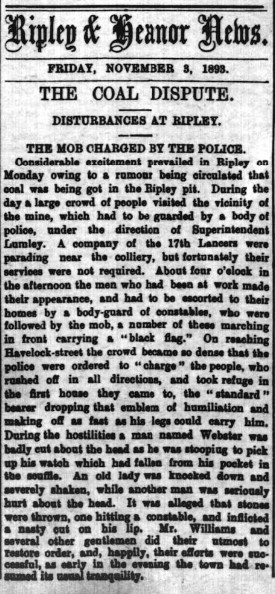
Rumours persisted that men were extracting coal, and on Monday 30th October, a large crowd gathered at the Ripley colliery, which was being protected by a contingent of police. When men who had been working emerged, they had to be escorted by the police to their homes, followed by the crowd, carrying the black flag. When it arrived in Havelock Street, ‘the crowd became so dense that the police were ordered to “charge” the people, who rushed off in all directions, and took refuge in the first house they came to, the “standard” bearer dropping that emblem of humiliation and making off as fast as his legs would carry him’.[10]
The Derbyshire Advertiser that week described the ‘excitement’ at Ripley as intense.[11] The following day feelings were still running high in the town and hundreds of miners again gathered at Ripley pit, waiting for the men who were at work to emerge from the pit. The pit comprised several shafts, however, and miners could be quietly brought out at Waingroves without anyone noticing. But this time Corfield was the target of their anger.
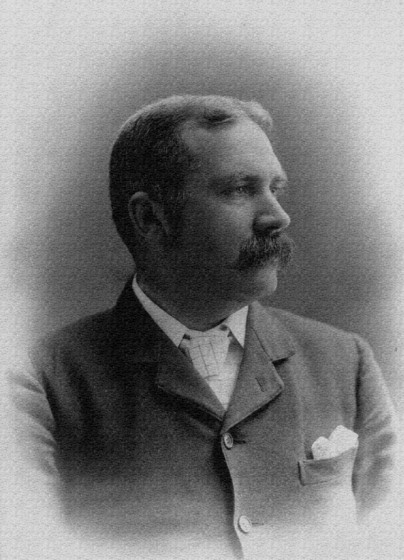
Frederick Channer Corfield, manager of the Butterley Company
He was escorted from the Colliery by police, followed by a large crowd, berating him. Corfield fired his revolver above their heads, upon which stones were thrown at him. On reaching his residence at Ormonde Fields, he went upstairs with his wife and threatened to fire on the mob if they went near his house. The crowd proceeded to break fences, greenhouse windows and gates. A large group of police managed to prevent further damage to the property, and a detachment of the 17th Lancers was sent to protect Corfield’s home and the colliery.[12] In an interview with the Ripley correspondent of the Nottingham Daily Express a few days after the incident, Corfield claimed that he had been in the service of the Butterley Company for 26 years and had never received such insults from the men in the employ of the Company as he had the previous week.
Next day, pickets were despatched to all points where men might access or leave the pit. Throughout the day, miners paraded the streets of Ripley, brandishing a black flag with the inscription ‘Blacklegs’ chalked on it, in the hope of an encounter with the men who had returned to work. The men’s homes had been protected overnight by a group of constables. That evening, Harvey addressed a large meeting at the Public Hall, saying that ‘it had come to a sorry state of things that one man resident at Ormonde Fields, Codnor, could send for 100 policemen and soldiers’. Concerned about the threat to blacklegs’ lives, he threatened to bring out the enginemen from Butterley’s pits, after which they would be flooded, rather than see a life lost in a riot.
A few days later, in a bid to reduce the simmering tension, Corfield offered to re-open Butterley’s collieries at the old rates until 26th December, after which a 15% reduction would be applied. These terms were unanimously rejected by the unions. Corfield had no dealings with the union’s representatives, and refused to allow two men, William Trevitt and William Hardy, to be part of the deputation to which he made his offer. Trevitt, along with John Lowe, of Codnor, was also accused of a leading role in the recent
riot. At the meeting, Corfield asked the deputation, from Plumptre Colliery, for men ‘to be quiet when he was travelling about, and not hoot him whenever he made his appearance’.[13] If they did, he could dispense with the police protection he felt obliged to use. Trevitt told a meeting of Butterley miners on 15th November that he harboured no ill-will towards Corfield and felt sure no one would want to harm him. He urged the men to show their respect and suggested Corfield might wish to attend a meeting, where he would be given a fair hearing. The meeting, held at Co-operative Hall in Ripley, unanimously rejected Corfield’s offer.
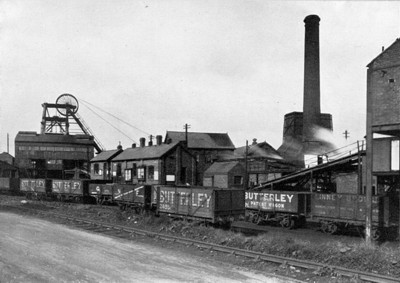
Britain colliery, near Ripley, owned by the Butterley Company
As hardship in the district intensified, relief efforts stepped up. Friendly societies were prevented by law from making donations to the families of the locked out miners, but the Co-operative movement had no such constraints, and pitched in generously to the relief funds. Ripley Co-operative Society had passed a resolution as early as August to allow members to draw down 1s without coming before the Committee. Miners were provided the use of the Co-operative Hall free of charge for meetings. It also distributed £150 per week among its branches for provisions to be donated to those in need. Later that year, in a report on the Relief Fund, the Secretary stated that:
‘for thirteen weeks the Committee have been engaged in distributing the funds entrusted to them. Local Committees consisting of members of the Society were appointed at each of the thirteen places where the Society carries on business. These Committees distributed the amounts allotted to them by the General Committee, over 20,000 relief tickets having been issued,and in most cases delivered to save postage, and all services have been given gratuitously’.[14]
Remarkably for the time, a total of £1,170 9s 4d was donated by the Society to alleviate distress ‘that grew more acute each week’. The Co-op stores were ideally situated in mining communities, with branches in Butterley Hill, Somercotes, Codnor, Swanwick, Riddings, Alfreton, Westwood, Kilburn, Heanor, South Normanton, Marehay, Blackwell, and Lea Brooks. Miners and associated trades must have made up a significant proportion of Co-operative Society members, as at the end of 1893, the share capital account of the Ripley Society had decreased by nearly £7,000 as a result of members’ claims since July.[15]
The generosity of the Co-op in Ripley was not forgotten, however. Local communities repaid its charitable efforts and by 1895 the share capital of the Society had grown by £13,506 to £65,171. As the Jubilee History of the Society concludes of the 1893 lockout : ‘The recollection of this weary struggle will awaken many painful thoughts; the endurance of families will never be forgotten, and the way in which the Society met the extraordinary demands made upon it will be handed down from one generation to another’.[16]
Ironworkers, who were not directly involved but could not work without coal, had their own relief committees. By November, suffering at Ironville, the model village built by the Butterley Company to house workers at Codnor Park, was intense. 450 loaves, 180 lbs of meat and 100 packets of tea were distributed to families at Codnor Park that month. Unfortunate victims of the lockout, the Codnor Park workers were already on a short working week before the dispute, but had now been idle for many weeks without any strike pay. In a letter to the Derby Daily Telegraph on 19th October, a correspondent wrote that :
‘great want and destitution prevail, especially about Riddings, Swanwick and Codnor Park. The famished appearance of some of the women is pitiable, the hard-earned savings in many a home have gone, and now the clothes of some of these poor people have to go also. Very few men have returned to work, and there are no signs of the majority doing so as the Butterley Company and Messrs Oakes and Company (owners of Alfreton Ironworks at Pye Bridge) threaten to keep their pits and works closed until Christmas, unless the men accept a reduction’.
Codnor Park men had rejected a proposal by the Butterley Company of a 10% reduction to return to work, so that coal could be brought in from other districts. This decision had been taken even though many families there were ‘practically destitute’.[17] Although a national settlement had been reached by this time, hardship in certain corners of the area persisted, with Ripley and Codnor particularly badly hit.
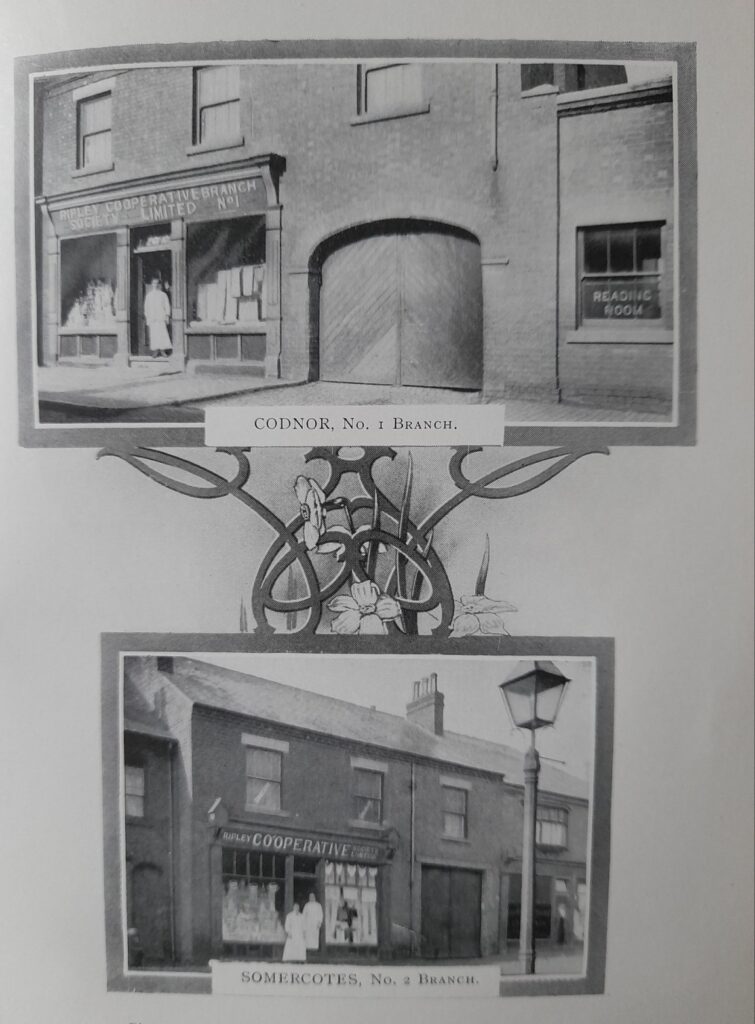
Codnor and Somercotes branches of the Ripley Co-operative Society (from ‘A Jubilee History of the Ripley Provident Industrial and Co-operative Society’)
At a meeting of Butterley miners on 15th November, Mr W Williams, Secretary to the Ripley Lodge of the DMA, reported that offers had come in from Eastwood for 100 miners’ children to be fed and housed until work resumed, and from Ilkeston, where Mr B Gregory, also of the DMA, pledged to find comfortable homes for 300 children in the Ilkeston district. Both offers were accepted, and on 18th November, 34 Ripley and Codnor children were taken to Ilkeston families where homes had been provided for them, followed by another 50 two days later.
William Harvey was critical of the Butterley Company which took an uncompromising stance in the Ripley area, but had re-opened its pits to 1,000 men in North Staffordshire on the old rates of pay. Mr Fitzherbert Wright wrote to the Ripley and Heanor News on 17th November, attempting to address the inconsistent approach, arguing that North Staffordshire coal owners had decided to resume on the old rates, but that his company retained the belief that a reduction should be applied. He had been effectively outvoted in that area, but even on the day a national settlement was reached, the Company was clearly prepared to keep their men locked out in Derbyshire.
As Ripley children were being moved to other towns to be fed, a national agreement was drawn up in London, for a settlement and return to work on the old rates, at least until 1st February 1894. A Board of Conciliation was to be established to determine wage rates from then on. The long dispute was finally at an end. On 24th November, the Ripley and Heanor News reported that Butterley workers had returned that week at Heanor, Loscoe, Langley Mill and Eastwood. Officials from Pinxton No 2 and 3 pits were unable to say when they would be re-opened, but work would be found for the men elsewhere. The Metropolitan Police were withdrawn from the area, and the 17th Lancers, stationed for many weeks at Alfreton, left that week for Liverpool. The paper’s leader, with considerable relief, read ‘The War Ended’.
Phil Henshaw
(This is an extract from ‘Armageddon in the Erewash Valley: the impact of the 1893 miners’ lockout on communities in an East Midlands coalfield’)
[1] Ripley and Heanor News 21/7/1893
[2] Griffin, History of the Nottinghamshire Miners p91
[3] Ripley and Heanor News 29.9.1893
[4] Ripley and Heanor News 3.11.1893
[5] Healey Hero; NB: it also owned pits in North Staffordshire; The Nottingham Daily Express on 2.11.93 claimed that it owned 13 pits in Derbyshire and Nottinghamshire
[6] Stevenson, A Peoples History of Derbyshire Chapter 7
[7] See Healey Hero www.healeyhero.co.uk
[8] Wyncoll, P – The Nottingham Labour Movement 1880-1939 pp71-2
[9] Derbyshire Times 23.7.1887
[10] Ripley and Heanor News 3.11.1893
[11] Derbyshire Advertiser 10.11.1893
[12] Ripley and Heanor News 3.11.1893
[13] Ripley and Heanor News 17.11.1893
[14] Jubilee History of Ripley Co-operative Society p90
[15] Ibid p91
[16] Ibid p91
[17] Nottingham Daily Express 13.11.1893